Polarization Nation
Hi Subscriber First Name,
This week I’d like to invite you to engage in a thought exercise with me. What if 9/11 happened today?
On the night of September 11, after the horrible attacks of that morning, every single member of Congress stood shoulder to shoulder on the steps of the U.S. Capitol singing God Bless America. Overnight, a sea of American flags went up throughout our nation: in shop windows, country clubs, housing projects - even the local Quds Force office. For a shining moment America was united. Now, two decades later, if Congress stood on the steps of the Capitol to sing, half of them would sing Jason Aldean’s Try That In A Small Town, the other half, Childish Gambino’s This Is America, while Matt Gaetz cried like a spoiled little baby.
A few events from the intervening years help us imagine how our disunited states would respond to a terrorist attack today. When COVID first struck, in my endless political optimism, I actually thought that the pandemic would bring our country together. I know! And again, naive me truly believed that the horrible January 6 assault on the nation’s capital would somehow knit our nation together. Hope springs eternal. And irrational. So as you and your students explore the question of a 9/11 today, I have some explanations (always with a visual!) below.
Media balkanization.
In 2001, MSNBC and FOXNews were cable-babies - only five years old - and their viewers hadn’t withdrawn into their own ideological echo chambers. Social media, where a growing number of us now get our “news”, has become a cesspool of misinformation - X (the website formerly known as Twitter) has fired almost all of its trust and safety team - and AI now generates fake pictures and video confusing the public into believing whatever they want to believe.
Trust
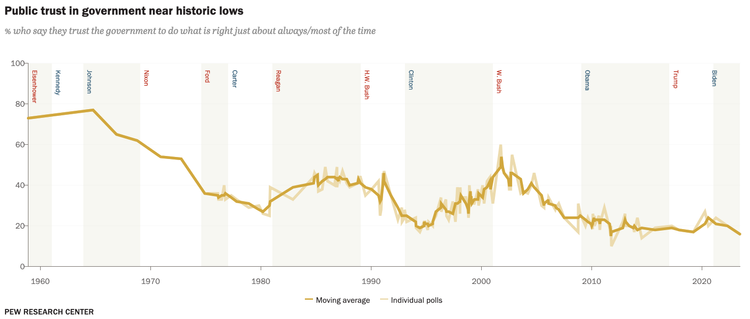
Americans’ overall level of trust has plummeted in the last two decades. In 2001, over 60% of Americans trusted the government. Today that number is 16%! We don’t trust congress, the president, the courts, the media, Tonya Harding, the federal government, state government, local government, or even each other. It’s hard to unite people who don’t even trust each other.
Raccoons
Let’s just say it. They probably own some blame for this. They’re such sneaky little beasts!
Let’s hope, of course, that America is never attacked again, by terrorists, viruses, our own citizens, or giant winged space-beagles. But remember, America has been far more torn than it is today - the civil war; the civil rights movement; Yanny or Laurel - and if we work to understand how we got here, and work to fix it, I know that We The People can unite.
Our GoPo Archive has got tons of charts, graphs, and maps about polarization, and you’ll also find this brand new political polarization lab where students can dive deep into an investigation into political polarization in their own community.

Join our GoPo Resources Archive for our brand new polarization lab and many more great resources.
Ask your school to pay for this - we take school purchase orders with glee!

Meet John Maynard! Neither winged nor from outer space - but very minxy.