How Diverse is your School?
Critical Analysis
Find answers to the following questions using the visual above, your big brain, the information provided and any links below:
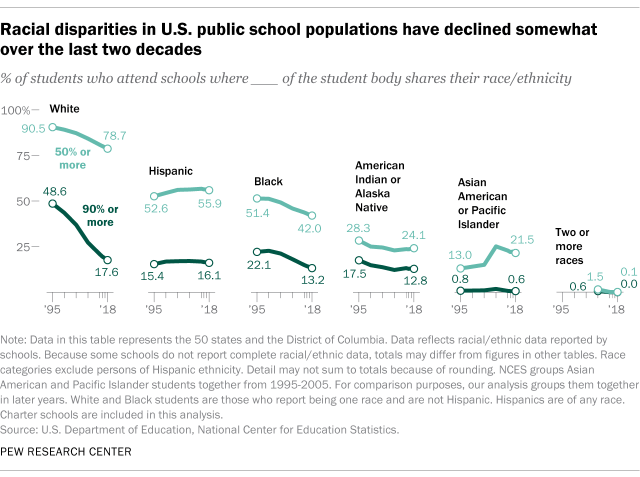
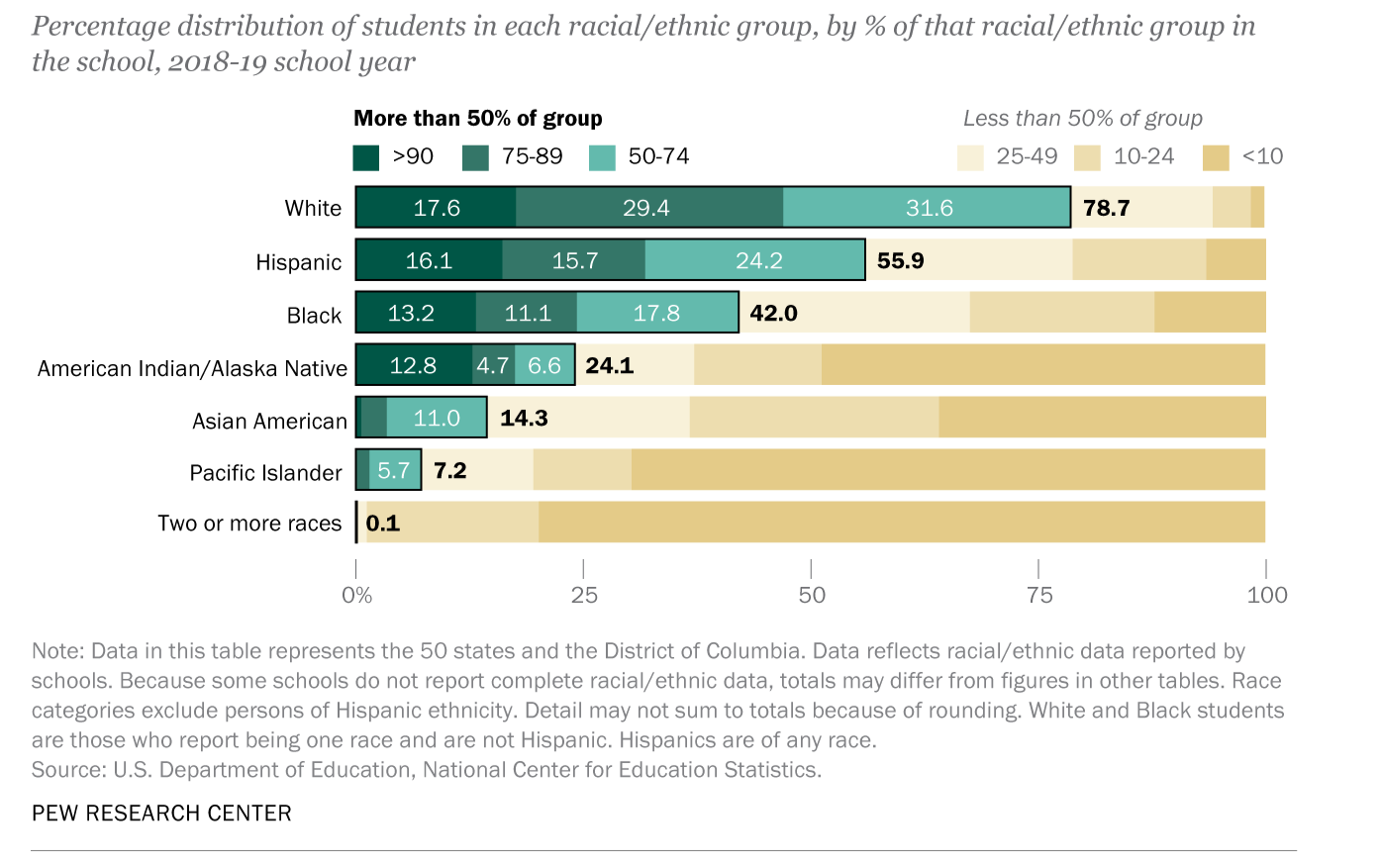
Based on the data from the chart above, what percentage of White students attend public schools where over half of the students are White?
What racial or ethnic group in America is most likely to attend a school with students from different racial and ethnic backgrounds?
In 1896, in Plessy v. Ferguson, the Supreme Court ruled that “separate but equal” (which meant segregation of schools, movie theaters, train cars, water fountains, swimming pools, and many public aspects of life) was constitutional. 58 years later, Brown v. Board struck down the Separate but Equal doctrine, ruling that segregation was unconstitutional. Upon what Constitutional basis did The Brown ruling rest?
Before Brown v. Board of Education (1954), by law, most students (especially students in the South) were forced to attend segregated schools. In fact, had the chart above existed in 1954, almost 100% for White and Black children would have gone to school with only students of their own racial and ethnic background. We are now over a half-century past Brown v. Board. Why do you think that even 50+ years after Brown v. Board, 78% of White students still go to majority White schools?
Many, but not all Americans supported the Plessy ruling and the American segregation of 1896. What had changed in American culture and society that led many Americans to oppose strict American racial segregation and apartheid by 1954.
Imagine that you wanted to write an essay to argue that American schools should be more integrated. What principle of American government might support your argument for integrated schools?
Imagine that you wanted to bring a suit to court to force American schools to be more integrated. What specific part of the Constitution would you use as the basis for an argument that the rights of American students are being violated.
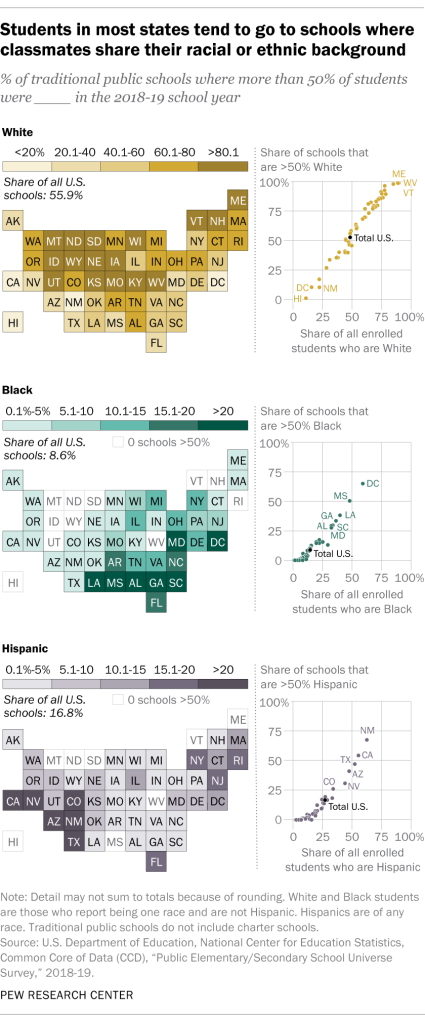
Describe the demographics of your current school and explain how it would fit on the chart above.
Diversity is the practice or quality of including or involving people from a range of different social and ethnic backgrounds and of different genders, sexual orientations. Equity is defined as the quality of being fair and just, especially in a way that takes account of and seeks to address existing inequalities. Inclusion is the practice or policy of providing equal access to opportunities and resources for people who might otherwise be excluded or marginalized, such as those who have physical or intellectual disabilities and members of other minority groups. President Trump considers DEI (Diversity, Equity, and Inclusion) to be illegal and immoral. In his first week in office, President Trump issued a series of executive orders (EOs) targeting diversity, equity, and inclusion programs in the public and private sectors. These executive orders are designed to chill and prohibit lawful efforts to advance equal opportunity. On his first day in office, January 20, 2025, President Trump signed Executive Order 14151: Ending Radical And Wasteful Government DEI Programs And Preferencing. How do you think Trump’s anti-diversity programs will impact diversity in America’s high schools?
Do you agree with President Trump that think diversity, equity, and inclusion are immoral?
Write and Discuss
Take ten minutes to write about the question at the top of the page and then discuss with your classmates.
Act on your Learning
Research the demographics of your school to see how they compare to the chart above. Share your findings with your local news outlet.
Get Creative
Write your own executive order about diversity, equity, and inclusion.
Learning Extension
Read the entire Pew Report: U.S. public school students often go to schools where at least half of their peers are the same race or ethnicity.