Critical Analysis
Find answers to the following questions using the visual above, any links below, your big brain, and your knowledge of American government and politics:
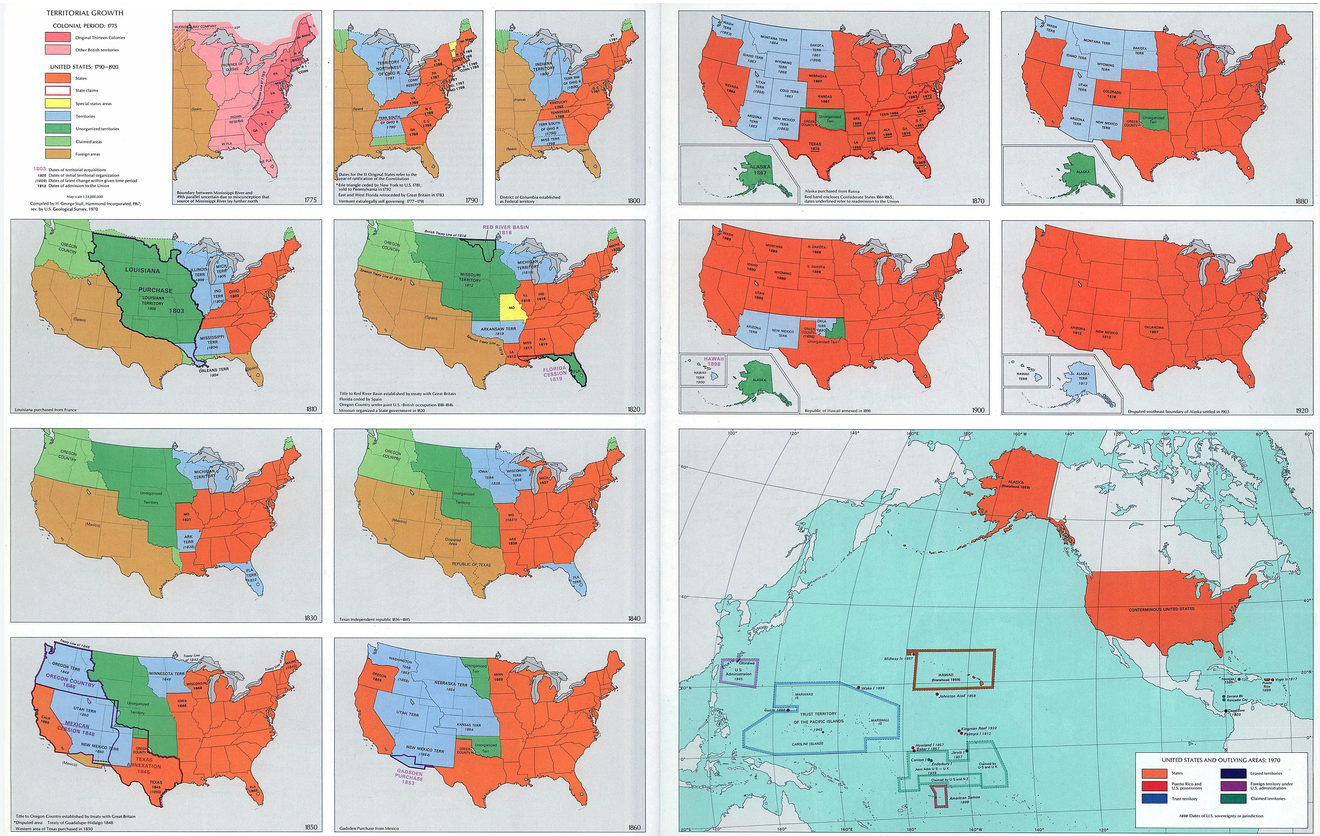
The Treaty of Paris was signed by U.S. and British Representatives on September 3, 1783, ending the War of the American Revolution, recognizing U.S. independence, and granting the U.S. significant western territory that stretched from the Appalachian Mountains to the Mississippi River, and from Canada to Spanish Florida. Besides the thirteen original colonies, what current U.S. states made up that original American territory?
A “territory” is a land area that has not yet been divided into states. No new territories were added to the United States for twenty years after the Treaty of Paris. In 1803, Napoleon Bonaparte surprised the Americans by offering to sell New Orleans and the whole Louisiana Territory for $15 million dollars. The Louisiana Purchase Doubled the size of the United States. What was the next territory added to the United States after 1783?
Only thirteen states ratified the Constitution pursuant to Article VII of the Constitution. All of the remaining thirty-seven states, starting with Vermont and ending with Hawaii, were subsequently admitted to the Union by Congress through Article IV, Section 3, Clause 1 of the United States Constitution which states, “New States may be admitted by the Congress into this Union; but no new State shall be formed or erected within the Jurisdiction of any other State; nor any State be formed by the Junction of two or more States, or Parts of States, without the Consent of the Legislatures of the States concerned as well as of the Congress.” Since the United States Constitution's ratification in 1789, the country has grown from 864,746 square miles to 3,531,905 through territorial acquisitions. Using the map above, identify the foreign countries that have lost or sold parts of their land to the United States.
Article VII of the Constitution required that 9 of the 13 states had to ratify the Constitution for it to become the law of the land. If the same ratio of current states was required to ratify the constitution today that would amount to 35 states. Do you think we could get 35 states to ratify the Constitution in this divided nation?
When was the area of the United States in which you live added to the United States and where did it come from? For example: I live in North Carolina (WHOOT!), which became part of the United States when ceded by Great Britain in 1783.
Although the United States has mostly expanded its territory since 1783, a significant amount of land has been ceded (given up) by the U.S. In The Treaty of 1818 between the United States and the United Kingdom. The two nations agreed to a boundary line involving the 49th parallel north. The British ceded all of Rupert's Land south of the 49th parallel and east of the Continental Divide, while the United States ceded the northernmost edge of the Missouri Territory north of the 49th parallel. In your opinion, which country got the better end of that deal?
In 1783, many Americans would have assumed that the country was done growing. Twenty years later they were proved wrong. The map above shows territorial expansion of the United States between 1783 and 1917. There are other territories that have been added to the United States empire that are not shown on the map above including: American Samoa, Guam, Northern Mariana Islands, and Puerto Rico. Explain whether you believe the United States will gain more territory, lose territory, or remain the same.
All the land of the United States was once home to American Indian nations. How different would the place we now know as the United States be if it had never been taken from those earlier inhabitants?
All the territorial acquisitions from the map above fulfilled the “manifest destiny” of the United States – that is, the belief that the nation should expand to the Pacific coast. As you look at the map do you think manifest destiny was a well organized plan or more of a haphazard slightly random addition.
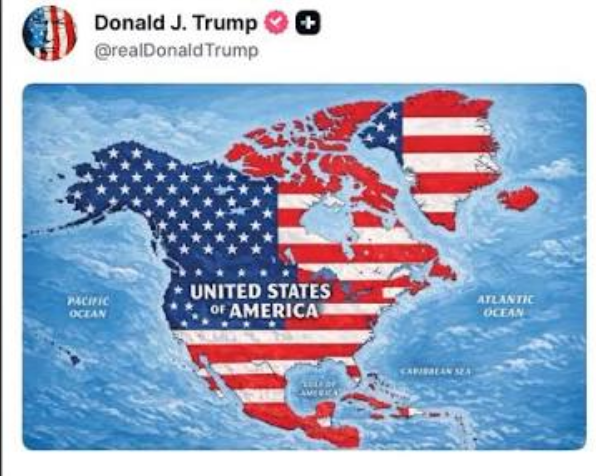
On September 7, 2026 President Trump share don his Truth Social account the map below* of the United States. What is geographically correct about his map and what is not?
Write and Discuss
Take ten minutes to write about the question at the top of the page and then discuss with your classmates.
Act on your Learning
In the United States, treaties regarding the exchange of territory with sovereign nations are typically initiated by the president and subject to the advice and consent of two-thirds of the U.S. Senate. According to Article II, Section 2, of the Constitution: “The President shall have Power, by and with the Advice and Consent of the Senate, to make Treaties, provided two-thirds of the Senators present concur... ” Contact the President and let him know what territory you think the U.S. should add to its current portfolio.
Call the White House
Phone Numbers
Comments: 202-456-1111
Switchboard: 202-456-1414
TTY/TTD
Comments: 202-456-6213
Get Creative
How has the expansion of U.S. territory impacted your community? Investigate and document the community where you live, consider other nations or people who have occupied your community and the impact of your community becoming a part of the United States. Share your results with your classmates.