What percent of U.S. Congress members are millionaires?
Critical Analysis
Find answers to the following questions using the visual above, any links below, your big brain, and your knowledge of American government and politics:
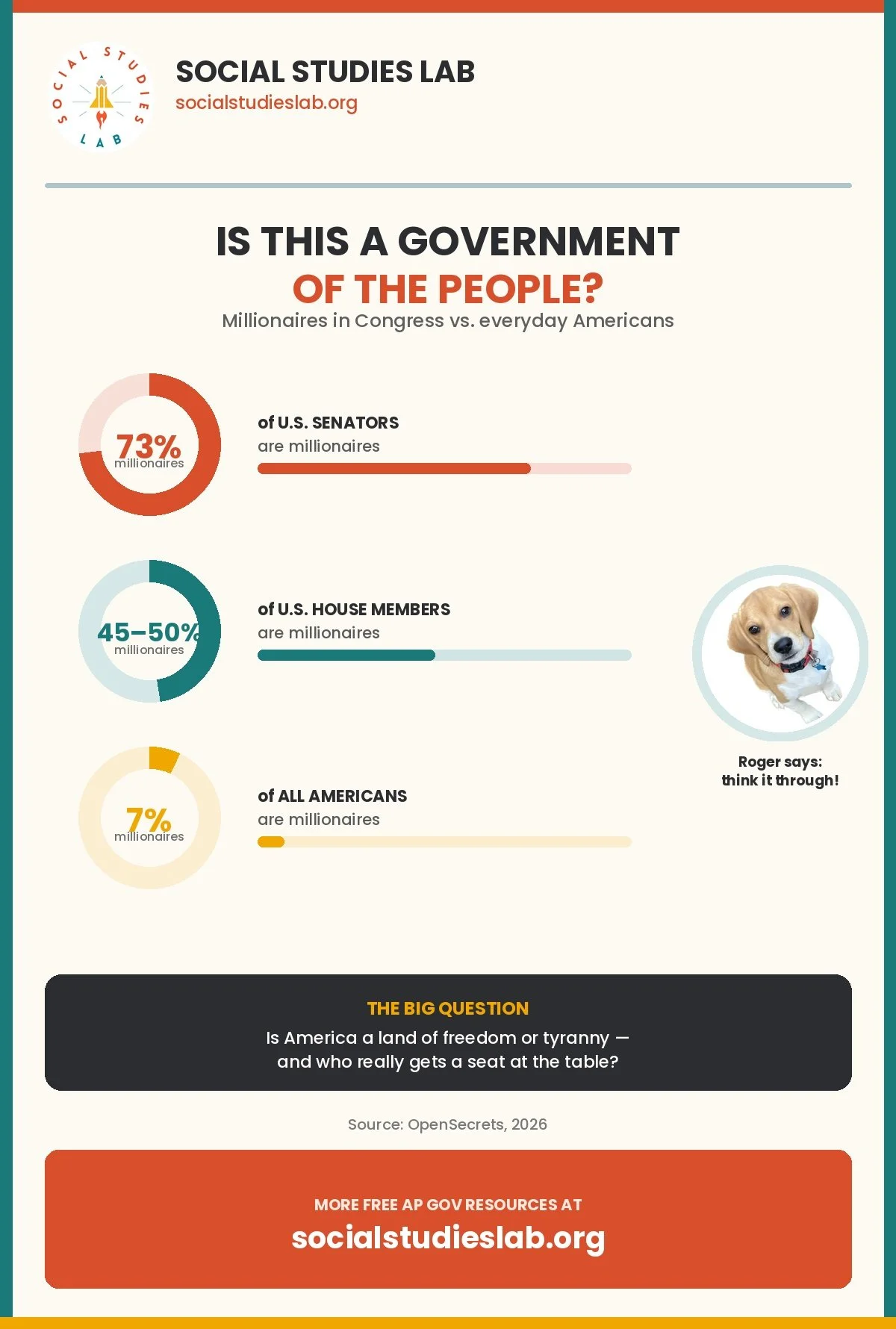
According to the visual above, as of 2026, approximately what percent of U.S. Senators were millionaires?
According to the visual above, as of 2026, approximately what percent of all Americans were millionaires?
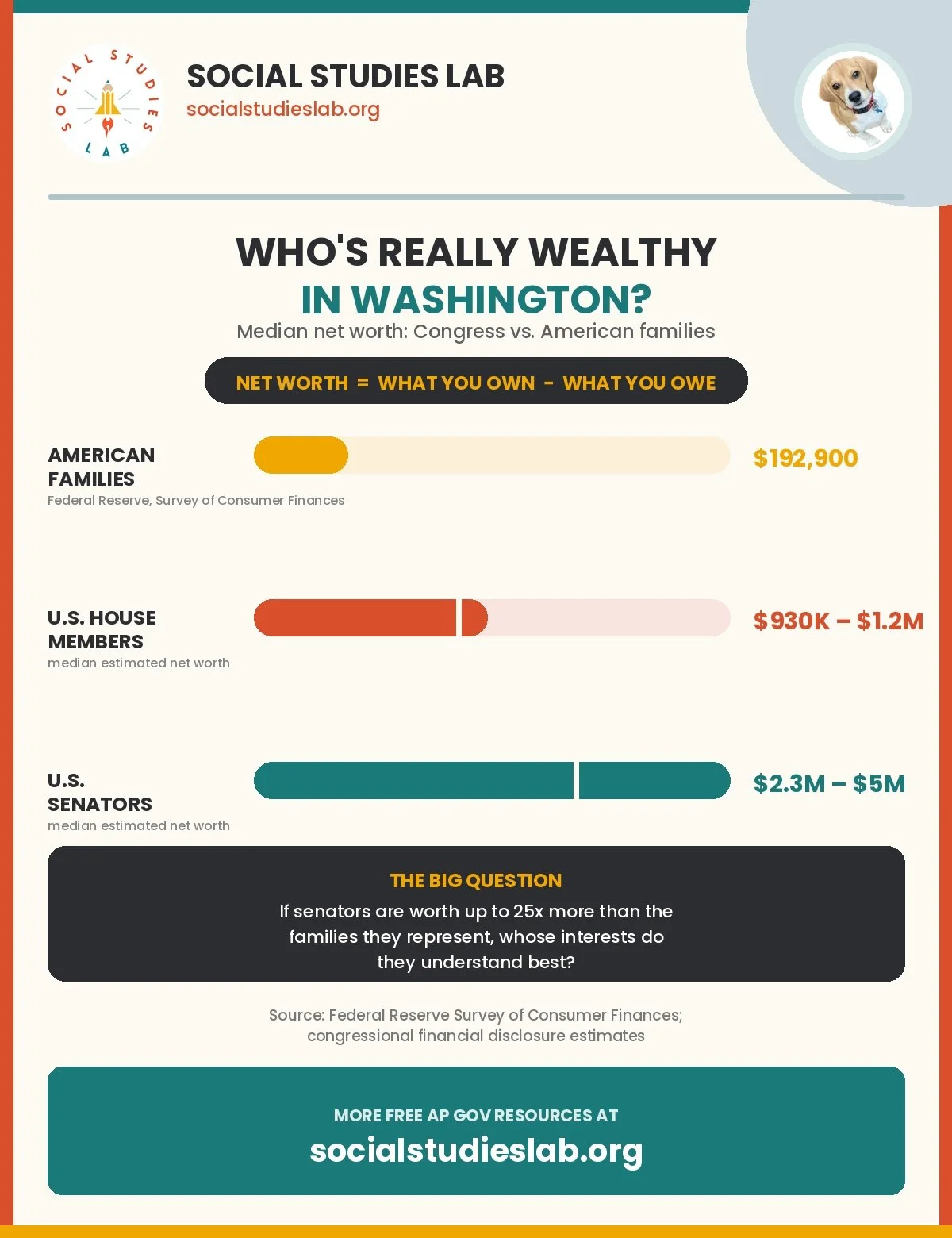
Net worth is what you own minus what you owe. As of 2026, the median net worth for members of the U.S. House of Representatives is roughly $930,000 to $1.2 million, while U.S. Senators have a higher median net worth of approximately $2.3 million to $5 million. According to the Federal Reserve Survey of Consumer Finances the overall median net worth for American families is $192,900. How do you explain the difference in American net worth and Congress net worth?
The Congress is bicameral, made up of the House and the Senate. Specific analyses of the Senate—often called a "millionaires' club"—show that at least 73% of sitting U.S. senators possess a median net worth greater than $1 million. Why do you think the Senate is more wealthy than the U.S. House?
From 1789-1815, U.S. senators were paid $6 per day. Today, most members of Congress: $174,000 per year with the House and Senate Majority and Minority Leaders: $193,400 per year; the President pro tempore of the Senate: $193,400 per year; and the Speaker of the House: $223,500 per year. Do you think members of Congress should be paid more?
Think about the kind of policy millionaires would favor and then think about the kind of policy that would benefit the average American. According to Bankrate's Annual Emergency Savings Report, 59% of Americans cannot cover a $1,000 unexpected expense using their savings. Most would be forced to rely on credit cards, borrow from family, or cut back on essentials. Only 46% of U.S. adults have enough money stowed away to cover three months' worth of living expenses. Nearly 1 in 4 Americans (24%) report having absolutely no emergency savings at all. Describe a consequence of Congress being dramatically wealthier than the average American.
If the average wealth of congress were the same as the average American, how would that change the kinds of laws Congress passes?
In the comments section, explain whether the US is more of a democracy (government by the people, for the people, and of the people) or a plutocracy (government by the wealthy, for the wealthy, and of the wealthy):
In Filthy Rich Politicians, conservative columnist Matt Lewis presents some startling figures. Senator Rick Scott: net worth of approximately $200 million. Representative Michael McCaul: $125 million. Nancy Pelosi: $46 million. In his book, Lewis takes a close look at how people get richer after they're elected to office, and what this wealth means for our political systems. Some would say that it is better to elect a rich person than an average person to Congress. How would you respond to that claim.
In addition to people who come to congress with great wealth, some members of congress see their wealth increase because of their time in office. Two-term Rep. Paul Mitchell (R-Mich.) saw the largest growth in wealth between 2017 and 2018. The former for-profit college executive’s average net worth skyrocketed from $101 million to nearly $180 million. Some longtime members of Congress watched their wealth rise to record levels in 2018. Rep. Collin Peterson (D-Minn.) was worth an estimated $123,500 in 2008. The House Agriculture Committee chairman’s average net assets stood at $4.2 million as of his most recent financial disclosure. Rep. Judy Chu (D-Calif.) was worth less than six figures in 2008. One decade later her estimated net worth sat at $7.1 million. Sen. Roy Blunt (R-Mo.) increased his wealth from $602,000 to $10.7 million over the last decade. Make a claim about whether there should be more restrictions on politicians generating wealth during their time in office.
Write and Discuss
Take ten minutes to write about the question at the top of the page and then discuss with your classmates.
Act on your Learning
Call the capitol switchboard at 202-224-3121 and ask to speak with your House Representative or Senator. Ask them or their staff if they are a millionaire. Share their response with your classmates.
Get Creative
If you were a millionaire, what is the first thing you what would buy?
If you were a millionaire, who is the first politician you what would buy
Learning Extension