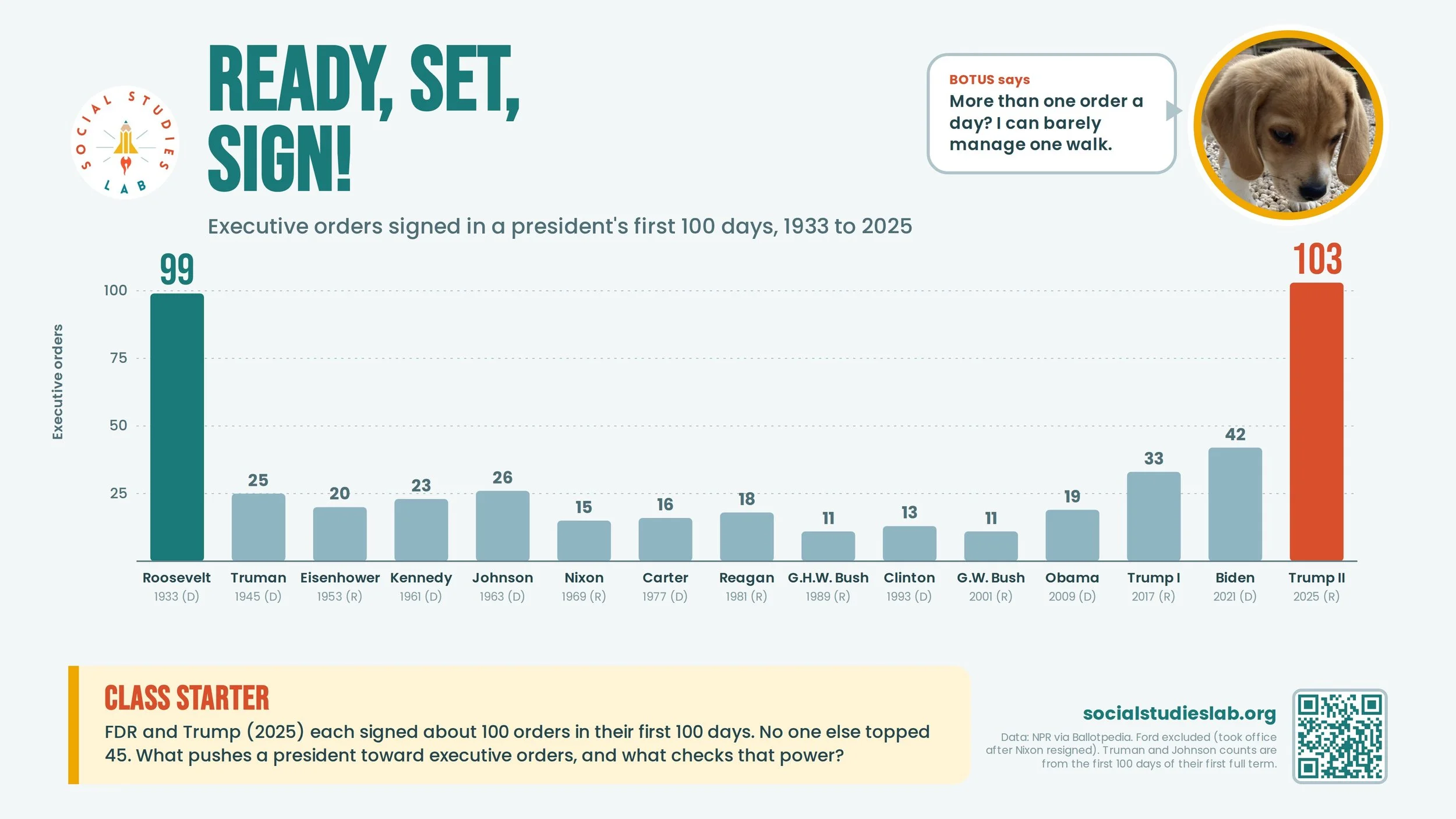
The data that powered this visual provided by GoPo teaching legend, Thalia Serino, Social Studies Department Chair, Floyd E. Kellam High School - Go Knights!
Critical Analysis
Find answers to the following questions using the visual above, any links below, your big brain, and your knowledge of American government and politics:
An executive order is a written directive from the president of the United States that manages the federal government. Executive orders have the force of law and are used to direct the executive branch. According to the data from the visual above, which president signed the fewest executive orders in their first 100 days in office?
According to the data from the visual above, which president signed the most executive orders in their first 100 days in office?
According to the data from the visual above, by February 5, 2026 the 100th day of his presidency, Donald J. Trump had signed 103 executive orders. How does Trump’s number of executive orders compare to other presidents since Dwight Eisenhower?
President shown in the visual above in are labeled as Democrats (D) or Republicans (R). Describe how Democratic and Republican presidential executive orders compare.
According to the data from the visual below* how many of Trump’s executive orders were revocations of his predecessor’s executive orders?
Like many presidents, President Biden revoked many of his predecessor, Donald Trump’s executive orders. Likewise, Trump has now revoked many of Biden’s executive orders. Explain why presidents (Imagine a successor democratic president: Alexandria Ocasio-Cortez or Travis Kelce?) evoke so many of their predecessor’s executive orders?
Before his inauguration, President Donald Trump vowed to sign 100 executive orders on his first day in office. And while he didn't hit that mark on Day 1, the number and breadth of executive actions he's taken in office has been historic. Executive orders serve another purpose too: "Unilateral activities … bolster Trump's image as the indispensable person in charge, the consummate leader, the strongman … And by acting unilaterally, he embodies the essential qualities of a strongman that many in his base desire," explains William Howell, a professor of political science and public policy at Johns Hopkins University. Some say the extensive use of executive orders shows the strength and power of a president, others say the opposite, that executive orders show that the president will not be able to advance his agenda through the legislature and thus must use the weaker and less durable executive order. Explain which side of this argument you are on.
If the judiciary declares an executive order unconstitutional, which branch of government would have to enforce their ruling by stopping the president’s executive order and how could this lead to a Constitutional crisis?
Browse through Trump’s executive orders from his second term in office and identify the one you most and the one you least agree with.
Throughout President Trump’s second term, Republicans have maintained unified control of government with majorities in both the House and Senate of the 119th Congress. Despite this single-party control, the 119th Congress has recorded a historically low volume of passed legislation. What factors might explain why President Trump has relied on executive actions rather than seeking more permanent policy solutions through the legislative process?
Write and Discuss
Take ten minutes to write about the question at the top of the page and then discuss with your classmates.
Act on your Learning
Email or call the President and let him know what you think about his recent executive orders. Call the President
Comments: 202-456-1111
Switchboard: 202-456-1414
Get Creative
Imagine you were president of the United States! Make your own executive order about anything you as president would order the executive branch to do and share it with your class.
Thank You
The data that powered this visual provided by GoPo teaching legend, Thalia Serino, Social Studies Department Chair, Floyd E. Kellam High School - Go Knights!
Learning Extension*
Teaching AP Government is a marathon, and every class period needs a strong start. The Liberty Bell Ringer Membership gives you an archive of 1,000+ ready-to-go bell ringers. But it doesn't stop there. When it's time to mix things up, dig into a growing library of whole-class games your students will actually enjoy. And when May draws near the built-in exam prep has you covered. Cancel at any time. Use promo code SIGNMEUP at checkout to get the first month of our monthly subscription for free!


Roger the Puppy
-
Amendments
11
- Nov 18, 2026 Twenty Second Amendment
- Nov 18, 2026 Fourteenth Amendment
- Nov 18, 2026 Ninth Amendment
- Nov 18, 2026 Seventh Amendment
- Nov 18, 2026 Sixth Amendment
- Nov 18, 2026 Fifth Amendment
- Nov 18, 2026 Fourth Amendment
- Nov 18, 2026 Second Amendment
- Nov 18, 2026 First Amendment
- Nov 16, 2026 Tenth Amendment
- Nov 16, 2026 Eighth Amendment
-
Foundational Documents
9
- Nov 18, 2026 Letter From Birmingham Jail
- Nov 18, 2026 Federalist No. 78
- Nov 18, 2026 Federalist No. 70
- Nov 18, 2026 Federalist No. 10
- Nov 18, 2026 Brutus 1
- Nov 18, 2026 The United States Constitution
- Nov 18, 2026 Articles of Confederation
- Nov 18, 2026 Declaration of Independence
- Nov 16, 2026 Federalist No. 51
-
Supreme Court Cases
14
- Nov 18, 2026 McDonald v. Chicago
- Nov 18, 2026 Citizens United v. F.E.C.
- Nov 18, 2026 U.S. v. Lopez
- Nov 18, 2026 Shaw v. Reno
- Nov 18, 2026 Wisconsin v. Yoder
- Nov 18, 2026 New York Times v. US
- Nov 18, 2026 Tinker v. Des Moines
- Nov 18, 2026 Engel v. Vitale
- Nov 18, 2026 Brown v. Board of Education (1954)
- Nov 18, 2026 Schenck v. United States (1919)
- Nov 18, 2026 McCulloch v. Maryland (1819)
- Nov 18, 2026 Marbury v. Madison (1803)
- Nov 16, 2026 Gideon v. Wainwright
- Nov 13, 2026 Baker v. Carr (1962)
-
UNIT 1
39
- Nov 19, 2026 Limited Government
- Nov 18, 2026 Natural Rights
- Nov 18, 2026 Enumerated Powers
- Nov 18, 2026 Shays' Rebellion
- Nov 18, 2026 Interstate Compact
- Nov 18, 2026 Block Grant
- Nov 18, 2026 Categorical Grant
- Nov 18, 2026 Autocracy
- Nov 18, 2026 Referendum
- Nov 18, 2026 Framers
- Nov 18, 2026 Separation of Powers
- Nov 18, 2026 Tyranny
- Nov 18, 2026 State Capture
- Nov 18, 2026 Checks and Balances
- Nov 18, 2026 Fiscal Federalism
- Nov 18, 2026 Social Contract
- Nov 18, 2026 New Jersey Plan
- Nov 18, 2026 Connecticut Compromise/Great Compromise
- Nov 18, 2026 Virginia Plan
- Nov 18, 2026 Bicameralism
- Nov 18, 2026 Federal Mandate
- Nov 18, 2026 Participatory Democracy
- Nov 18, 2026 Concurrent Powers
- Nov 18, 2026 Reserved Powers
- Nov 18, 2026 Popular Sovereignty
- Nov 18, 2026 Commerce Clause
- Nov 18, 2026 Federalism
- Nov 18, 2026 Elite Democracy
- Nov 18, 2026 The United States Constitution
- Nov 18, 2026 Articles of Confederation
- Nov 16, 2026 Pluralist Democracy
- Nov 16, 2026 National Supremacy
- Nov 16, 2026 Extradition
- Nov 16, 2026 Federalist No. 51
- Nov 16, 2026 Necessary and Proper Clause
- Nov 16, 2026 Expressed Powers
- Nov 16, 2026 Implied Powers
- Nov 13, 2026 Refugee
- Nov 13, 2026 Preemption
-
UNIT 2
62
- Nov 18, 2026 Executive Order
- Nov 18, 2026 Congressional Committees
- Nov 18, 2026 Rule Making Authority
- Nov 18, 2026 Congressional Oversight
- Nov 18, 2026 Federal Communications Commission (FCC)
- Nov 18, 2026 Environmental Protection Agency (EPA)
- Nov 18, 2026 Speaker of the House
- Nov 18, 2026 Reapportionment
- Nov 18, 2026 Government Shutdown
- Nov 18, 2026 Department of Education
- Nov 18, 2026 Signing Statement
- Nov 18, 2026 Judicial Review
- Nov 18, 2026 Full Faith and Credit Clause
- Nov 18, 2026 Shadow Docket
- Nov 18, 2026 Federal Election Commission (FEC)
- Nov 18, 2026 Commander in Chief
- Nov 18, 2026 Congressional Whip
- Nov 18, 2026 Filibuster
- Nov 18, 2026 Unitary Executive Theory
- Nov 18, 2026 Executive Aggrandizement
- Nov 18, 2026 Closed Rule
- Nov 18, 2026 Trustee
- Nov 18, 2026 Redistricting
- Nov 18, 2026 Pardon
- Nov 18, 2026 Divided Government
- Nov 18, 2026 Regulatory Capture
- Nov 18, 2026 Stare Decisis/Precedent
- Nov 18, 2026 Federal Reserve
- Nov 16, 2026 Impeachment
- Nov 16, 2026 Politico
- Nov 16, 2026 Cloture
- Nov 16, 2026 Independent Agencies/Commissions
- Nov 16, 2026 Rule of Four
- Nov 16, 2026 Federal Bureaucracy
- Nov 16, 2026 Delegate
- Nov 16, 2026 Civil Service
- Nov 16, 2026 Safe Seats
- Nov 16, 2026 Impoundment
- Nov 16, 2026 Entitlements
- Nov 16, 2026 Executive Privilege
- Nov 16, 2026 Presidential Honeymoon
- Nov 16, 2026 Unified Government/Party Government
- Nov 16, 2026 Merit System/Spoils System
- Nov 13, 2026 Pocket Veto
- Nov 13, 2026 Chief of Staff
- Nov 13, 2026 National Security Council
- Nov 13, 2026 Senate Confirmation
- Nov 13, 2026 Cabinet
- Nov 13, 2026 Rally Point
- Nov 13, 2026 Logrolling
- Nov 13, 2026 Regulation
- Nov 13, 2026 Gross Domestic Product (GDP)
- Nov 13, 2026 Executive Office of the President
- Nov 13, 2026 Party Caucus
- Nov 13, 2026 Gerrymander
- Nov 13, 2026 Federal Register
- Nov 13, 2026 Congressional Budget Office
- Nov 13, 2026 Office of Management and Budget
- Nov 13, 2026 Conference Committee
- Nov 13, 2026 White House Staff
- Nov 13, 2026 Bureaucratic Rule-Making
- Nov 13, 2026 Treaty
-
UNIT 3
23
- Nov 18, 2026 Jim Crow Laws
- Nov 18, 2026 Amicus Curiae Brief
- Nov 18, 2026 Clear and Present Danger Test
- Nov 18, 2026 Free Exercise Clause
- Nov 18, 2026 Docket
- Nov 18, 2026 Racially Restrictive Covenants
- Nov 18, 2026 Exclusionary Rule
- Nov 18, 2026 Mass Movements
- Nov 18, 2026 Jury Nullification
- Nov 18, 2026 Establishment Clause
- Nov 18, 2026 Fourteenth Amendment
- Nov 18, 2026 Tinker v. Des Moines
- Nov 18, 2026 Brown v. Board of Education (1954)
- Nov 16, 2026 Gideon v. Wainwright
- Nov 16, 2026 Selective Incorporation
- Nov 13, 2026 Civil Disobedience
- Nov 13, 2026 Plea Bargain
- Nov 13, 2026 Fighting Words
- Nov 13, 2026 White Primary
- Nov 13, 2026 Commercial Speech
- Nov 13, 2026 Baker v. Carr (1962)
- Nov 13, 2026 Double Jeopardy
- Nov 13, 2026 Eminent Domain
-
UNIT 4
27
- Nov 18, 2026 Public Opinion
- Nov 18, 2026 Sampling Error
- Nov 18, 2026 Socialism
- Nov 18, 2026 Deficit
- Nov 18, 2026 Extrajudicial Killing
- Nov 18, 2026 Discretionary Spending
- Nov 18, 2026 Mandatory Spending
- Nov 18, 2026 The Big Sort
- Nov 18, 2026 Liberalism
- Nov 18, 2026 Exit Polls
- Nov 18, 2026 Conservatism
- Nov 18, 2026 Libertarianism
- Nov 18, 2026 Political Ideology
- Nov 18, 2026 Monetary Policy
- Nov 18, 2026 Political Socialization
- Nov 18, 2026 American Dream
- Nov 18, 2026 Political Culture
- Nov 18, 2026 Rule of Law
- Nov 18, 2026 Debt
- Nov 18, 2026 Tariff
- Nov 18, 2026 Gender Gap
- Nov 18, 2026 Political Efficacy
- Nov 18, 2026 Ethnocentrism
- Nov 18, 2026 Cross-Cutting Cleavages
- Nov 18, 2026 Reinforcing Cleavages
- Nov 16, 2026 Political Norms
- Nov 16, 2026 Fiscal Policy
-
UNIT 5
35
- Nov 18, 2026 Party Platform
- Nov 18, 2026 Term Limits
- Nov 18, 2026 Packing
- Nov 18, 2026 Off-Year Election
- Nov 18, 2026 Voter Turnout
- Nov 18, 2026 Horse Race Journalism
- Nov 18, 2026 Media Bubble/News Bubble/Echo Chamber
- Nov 18, 2026 Dark Money
- Nov 18, 2026 Dummymander
- Nov 18, 2026 Propaganda
- Nov 18, 2026 Attentive Public
- Nov 18, 2026 Purple State/Swing State
- Nov 18, 2026 Selective Exposure
- Nov 18, 2026 Cracking
- Nov 18, 2026 Bundling
- Nov 18, 2026 Caucus Election
- Nov 18, 2026 Red State
- Nov 18, 2026 Bipartisan
- Nov 18, 2026 Name Recognition
- Nov 18, 2026 Single Member District
- Nov 18, 2026 Party Convention
- Nov 18, 2026 Lobbyist
- Nov 18, 2026 PAC
- Nov 18, 2026 Midterm Election
- Nov 18, 2026 Primary Election
- Nov 18, 2026 Political Polarization
- Nov 18, 2026 Super PAC
- Nov 18, 2026 Blue State
- Nov 18, 2026 Rational Choice Theory
- Nov 16, 2026 Linkage Institutions
- Nov 16, 2026 Coattail Effect
- Nov 16, 2026 Party-Line Voting
- Nov 13, 2026 Party Identification
- Nov 13, 2026 Realigning Election
- Nov 13, 2026 Closed Primary