Who were the delegates to the Constitutional Convention?

Critical Analysis

Find answers to the following questions using the visual above, any links below, your big brain, and your knowledge of American government and politics:

  1. 55 men met in Philadelphia, Pennsylvania, from May 25 to September 17, 1787, to draft the United States Constitution, replacing the existing Articles of Confederation. The average age of the delegates was 42, and four of the most influential delegates—Alexander Hamilton, Edmund Randolph, Gouverneur Morris, and James Madison—were in their thirties. Jonathon Dayton the youngest delegate was only 26 years old, Benjamin Franklin, the oldest, was 81! According to the visual above, how many of the men at the Constitutional Convention were in their 20s?

  2. According to the visual above, what was the most common age of the White men at the Constitutional Convention?

  3. A constitution is a set of fundamental principles or established precedents according to which a state or other organization is governed. 11 of the delegates to the Constitutional Convention attended Princeton University - more than any other university. According to the visual above, how many of the 55 delegates did not attend any university?

  4. The United States Constitution is the oldest written constitution in the world that is still in use. According to the visual above, what was the most common occupation/professional background of the men at the Constitutional Convention?

  5. According to the visual above, 55 delegates were planters. How do you think the demographic makeup of the Constitutional Convention is most different from the current U.S. Congress.

  6. Of the 55 delegates to the Constitutional Convention, about 25 owned slaves. Although the word "slave" does not appear in the Constitution, slavery received important protections in the Constitution. The notorious three-fifths clause—which counted three-fifths of a state’s slave population in apportioning representation—gave the South extra representation in the House of Representatives and extra votes in the Electoral College. The Constitution also prohibited Congress from outlawing the Atlantic slave trade for twenty years. A fugitive slave clause required the return of runaway slaves to their owners. The Constitution gave the federal government the power to put down domestic rebellions, including slave insurrections. Although not included in the visual above, can you guess how many of the men who attended the Constitutional Convention were white?

  7. Despite 27 amendments over the past 238 years (one Amendment every 8.8 years), the basic framework of government written in The U.S. Constitution has remained mostly unchanged. Historian Jill Lepore argues that the Founders intended for the Constitution to change and be amended over time, but despite Article V of the U.S. Constitution which lays out the amendment process, “The U.S. Constitution has one of the lowest amendment rates in the world. Some 12,000 amendments have been formally introduced on the floor of Congress; only 27 have ever been ratified, and there has been no significant amendment in more than 50 years.” The U.S. Constitution is deliberately difficult to amend and requires a two-thirds vote in both houses of Congress and ratification by three-fourths of the state legislatures, making it a high bar to clear. How do you think political polarization (division) impacts the likelihood of amending the Constitution today?

  8. I like to tell my students that evolution stops revolution. Or as Jill Lepore more eloquently puts it, “Failing to amend the Constitution as needed and desired is a lost opportunity and sets a dangerous course. One of the Constitution’s founding purposes was…to allow for change without violence. Amendment is a constitution’s mechanism for the prevention of insurrection—the only way to change the fundamentals of government without recourse to rebellion.” Do you think the U.S. is likely to fundamentally change our government through amendment?

  9. This summer our nation has been rocked by political violence. Do you think we need a new Constitutional Convention to deal with this current political crisis?

  10. All 50 states have Constitutions, each with an amendment process. Unlike the federal Constitution, amending the constitution at the state level is a regular occurrence. Since 1789, some 7,000 amendments formally proposed in the states have been ratified, more than two-thirds of those introduced. Why do you think states are so much more likely to amend their constitutions than the national government is?

Write and Discuss

Take ten minutes to write about the question at the top of the page and then discuss with your classmates.

Act on your Learning

Read about the constitutional amendment process, write a proposal for a new amendment to the constitution, and send it to your congressional representative.

Get Creative

Create a profile of the average delegate to the Constitutional Convention.

Learning Extension

Read More

What is the most frequently used word in the U.S. Constitution?

The most commonly used words in the US Constitution

Critical Analysis

Find answers to the following questions using the visual above, any links below, your big brain, and your knowledge of American government and politics:

  1. The word democracy is not used in the U.S. Constitution. Neither are the words “flaming hot!” What is the most commonly used word in the Constitution?

  2. Federalism is the division of power between national and state governments. Explain the connection between federalism and the most commonly used word in the Constitution.

  3. I was surprised to find that the word President was used approximately twice as much as Congress. Why do you think the word President was used more than the word Congress?

  4. If Taylor Swift wrote an album about the Constitution using only the words of the Constitution but in any order she wanted how long would it take for that album to reach number one on the Hot Hundred Billboard Chart?

  5. The iconic opening of the Constitution "We the people of the United States" was actually used at the last minute. In earlier drafts, it read "We the people of the states of" (the individual states were listed from the north to the south). Why do you think they changed this language at the last minute?

  6. While the United States has been governed by a single framework of government for over two centuries, France, in contrast, has had 10 separate and distinct constitutional orders (including five republics, two empires, a monarchy, and two dictatorships). The country of El Salvador has had 36 constitutions since 1824. At the same time, many of the problems and issues our nation faces today would have been unimaginable by the 55 White men who wrote the U.S. Constitution in 1789. Make a claim (argument) about whether having an old Constitution is a good thing.

  7. The most commonly used words of the U.S. Constitution are laid out above. The Constitution lays out the powers and duties of the U.S. government. The most commonly used words of the Constitution and The Bill of Rights are illustrated in word clouds below.* What general principles are laid out in a Bill of Rights and how are those different from The constitution?

  8. The U.S.. Constitution is hard to amend? Only 17 Amendments (since the Bill of Rights) have been ratified. If you could amend our Constitution to add the concept of democracy what would that amendment look like?

  9. The U.S. Constitution basically says what the government can do and the Bill of Rights basically says what the government cannot do. The Federalists argued against having a Bill of Rights, the Anti-Federalists demanded a Bill of Rights. The Anti-Federalists won. The Bill of Rights was supposed to keep the government from becoming tyrannical. Did it work?

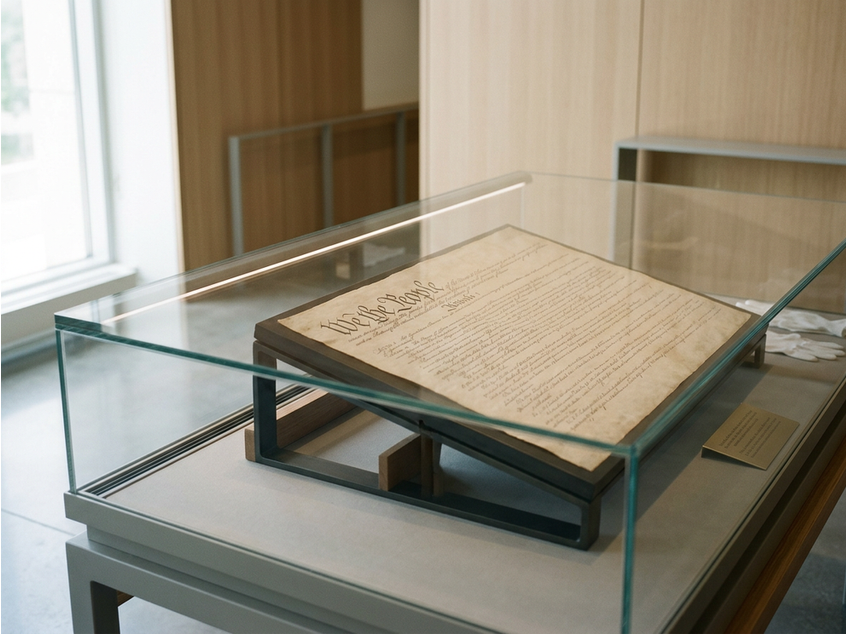
  10. The original Constitution is in a display case at the National Archives in Washington, D.C. The cases contain argon gas and are kept at 67 degrees Fahrenheit with a relative humidity of 40 percent to preserve the parchment papers. Did you know that? Now you do. What Taylor Swift memorabilia do you believe should also be kept at the National Archives?

Write and Discuss

Take ten minutes to write about the question at the top of the page and then discuss with your classmates.

Act on your Learning

An amendment may be proposed by a two-thirds vote of both Houses of Congress, or, if two-thirds of the States request one, by a convention called for that purpose. The amendment must then be ratified by three-fourths of the State legislatures, or three-fourths of conventions called in each State for ratification. Contact your U.S. representative and ask them to Amend the Constitution to either add the concept of democracy or the words, “flaming hot!”

Get Creative

Haiku is a Japanese form of poetry that has three lines. It has five syllables in the first and third lines. It has seven syllables in the second line. Its lines don't rhyme. Write a Haiku about the U.S. Constitution that you can share with older family members.

Learning Extension

Visit the Interactive Constitution at the National Constitution Center Website.


The most commonly used words in the Constitution

The most commonly used words in the Bill of Rights

AP Government Curriculum Toolkit - 2025-2026 Edition - Yearlong Version

Our 2025-2026 Edition Curriculum Toolkit includes:

Access to all our AP Government and Politics YEAR-LONG curriculum in a digital download with all resources in Google Docs

Loads of brand new Google Slides in every unit 🔆

Tons of keys for assignments, activities, and assessments 🔑

Curriculum that is completely aligned with the latest version of AP CED (course and exam description) skills and content.

Brand new expanded presidential election voting rights mini-unit

Fantastic lessons, reviews, and exams for every single day of the school year that will help your kids develop the knowledge and skills for success on the U.S. Government AP Exam.

Big question to connect learning across all units 💥

Updated fact sheets and backgrounders for big topics

Current events connection with new format throughout units 

inquiry-based learning resources and graphic organizers (with keys) for all of the 9 Foundational Documents like Federalist No. 10 and Letter from Birmingham Jail.

inquiry-based learning resources and graphic organizers (with keys) for all of the 14 Landmark Supreme Court Cases like US v Lopez and Engel v Vitale.

Great graphic organizers

Rigorous and creative unit projects (assignments, rubrics, assessments, and step-by-step guides) to prepare kids for the required AP Government project.

Test-prep tools for success on the AP Government and Politics exam including:

Step-by-step writing workshops to help students practice the skills for each of the four required FRQs, including the updated argument essay.

Exam Pro Tips to help students master the skills needed to attack the multiple choice test section.

A complete AP test bank with downloadable and online versions of 2 full-length exams (55 multiple choice questions, answer key, 4 FRQs and rubrics, each) and all 5 unit tests with multiple choice question and an FRQ for each unit.

Review Sheets for each unit test, including practice questions, vocabulary lists, and teacher keys for all court case and foundational document rubrics.

If you have any questions please contact me at jonathan@gopopro.com

we accept purchase orders
Read More
History Jonathan Milner History Jonathan Milner

How long did it take to ratify the Constitution?

Spark student learning and engagement with our 2025-2026 AP Government and Politics Curriculum Toolkit

Skip to Content

Home

AP Gov Curriculum

Store & Free Resources

Glossary

Contact

AP Gov Online Course

Login

How long did it take to ratify the Constitution?

Critical Analysis

Find answers to the following questions using the visual above, any links below, your big brain, and your knowledge of American government and politics:

  1. According to the data in the table above, on what date did the U.S. Constitution become the law of the land?

  2. According to the data in the table above, what state had the largest population at the time of the ratification of the U.S. Constitution?

  3. According to the data in the table above, three states unanimously approved the U.S. Constitution. Which states had the biggest opposition to the ratification of the Constitution.

  4. After America won her independence, the new country was governed by the Articles of Confederation, a document that attempted to build a nation out of the states. Under the Articles of Confederation the states acted more like independent, sovereign countries than as one united country. Why did the states reject the Articles of Confederation and join together to write a new Constitution?

  5. Much like Americans today, the delegates at the Constitutional Convention were politically divided. Those who craved a stronger national union were known as Federalists; those who wanted power to be concentrated at the state level so as to counter a tyrannical central government, were called Anti-Federalists. Explain whether you would have been a federalist or an anti-federalist?

  6. According to the data from the table above, even after New Hampshire’s ratification made the Constitution the law of the land, some of America’s biggest and most powerful states (Virginia and New York) barely ratified the Constitution. Why did some of the states hesitate to ratify the Constitution?

  7. Imagine that the ratification vote in New York changed by only 4 votes and was not approved. How would that have altered the history of the U.S. and what would the U.S. be like today?

  8. The Federalist Papers were written as an argument for ratification of the Constitution. You will study Federalist No. 10, No. 51, No. 70, and No. 78 this year (Yay, Federalist Papers!) The Papers were published on May 28, 1788. Why do you think they were published then?

  9. In the end the Federalists compromised with the Anti-Federalists, adding a Bill of Rights - guaranteeing individual liberties for all - to the Constitution in order to secure ratification. Explain how that constitutional compromise still impacts American politics today.

  10. Some would argue that the U.S, Constitution and the government it created were not powerful enough to solve the biggest problems of our times, such as Covid-19, the climate crisis, and the cost of health care. In general, given the magnitude of the problems we face today, do you think the Constitution gives the government too little or too much power?

Write and Discuss

Take ten minutes to write about the question at the top of the page and then discuss with your classmates.

Act on your Learning

There is a legal way to create a new constitution. Today, 34 of the 50 state legislatures would need to apply in order for Congress to call a constitutional convention. Contact your state legislators and ask them to propose a new constitutional convention!

Get Creative

Imagine we tried to ratify a constitution in today’s politically polarized (divided) society. Describe what that would be like in a one paragraph news report from the “2025 Constitutional Convention.”

Learning Extension*

Learn more about the day the Constitution was ratified at the National Constitution Center.

AP Government Exam Review Updated for 2026

Prepare for the 2026 AP® US Government Exam with High Five! Our Exam Review guide is completely redesigned and updated with over 140 pages of great AP Exam review material. Tons of completed graphic organizers are full of information to get you exam-ready in a flash.

This 2026 exam guide is an instant download and contains all the following resources.

  • Overview of the U.S. Government and Politics exam. 

  • Completed graphic organizers for all required documents + Supreme Court cases. 

  • Guide to the skills and content for all 5 course units. 

  • Essential vocabulary with link to online glossary.

  • Tons of Graphic Organizers with answers from each course unit.

  • GoPo Pro Tips and checklists.

  • Exam review Guides.

  • Amazing AI generated images of the Framers of the Constitution giving high fives!

  • Full Length AP multiple choice + Free Response Exam with Key.

AP ® is a trademark registered by the College Board, which is not affiliated with, and does not endorse, this site or product.

GoPoPro does not offer credit or grades for our classes or products.

PREVIEW HIGH FIVE NOW

Read More
History, US History, US Government Jonathan Milner History, US History, US Government Jonathan Milner

How easy is it to amend the U.S. Constitution?

Critical Analysis

Find answers to the following questions using the visual above, any links below, your big brain, and your knowledge of American government and politics:

  1. What article of the Constitution lays out the amendment process?

  2. What are the two steps in the Amendment process?

  3. Which of those steps has a higher threshold (requires more agreement) for success?

  4. Which part of which step of the amendment process has not yet been used?

  5. Amend means to modify formally, as a legal document or legislative bill. In more normal usage, amend also means to make better; improve; correct; reform. Why do you think the Framers of the Constitution added an amendment process to the Constitution.

  6. The United States currently has the world’s oldest and shortest written Constitution. Explain how the ability to amend the constitution has impacted its longevity.

  7. The U.S. Constitution was itself an act of amendment, written in 1787 because the Articles of Confederation were technically amendable but, for all practical purposes, not. At the constitutional convention in Philadelphia, the Virginia delegate George Mason, pointing out that everyone knew the Constitution that they were drafting was imperfect, argued that “amendments therefore will be necessary, and it will be better to provide for them in an easy, regular and constitutional way than to trust to chance and violence.” Did we created an easy and regular way to amend the Constitution?

  8. The U.S. Constitution, drafted in 1787, was written to be amended: mended, repaired, reformed, and improved. It hasn't exactly worked out that way. More than eleven thousand constitutional amendments were formally introduced on the floor of Congress between 1789 and 2021 and many thousands more have been proposed by the public, but only twenty-seven have ever been ratified, making the American Constitution one of the world's most difficult to amend. Why is our Constitution so hard to amend?

  9. The small number of Constitutional Amendments that have passed (27) would have surprised the nation’s founders, who knew the Constitution they had created was imperfect and who assumed that future generations would fix their mistakes and regularly adapt the document to changing times. “If there are errors, it should be remembered, that the seeds of reformation are sown in the work itself,” James Wilson said to a crowd in 1787. Years later, Gouverneur Morris wrote to a friend about the mind-set of the Constitution’s framers: “Surrounded by difficulties, we did the best we could; leaving it with those who should come after us to take counsel from experience, and exercise prudently the power of amendment, which we had provided.” Thomas Jefferson went further, proposing that the nation adopt an entirely new charter every two decades. A constitution “naturally expires at the end of 19 years,” he wrote to James Madison in 1789. “If it be enforced longer, it is an act of force, and not of right.” Imagine the Framers wanted to remake the Article V amendment process to make it easier. How would you recommend them to rewrite the amendment process?

  10. Since the Constitution was ratified, over 11,000 Amendments have been proposed but only 27 have been ratified. (I did the math. That's an average of one amendment every 8.66666666667 years!) What is one consequence of the difficulty of ratifying amendments to the U.S. Constitution?

Write and Discuss

Take ten minutes to write about the question at the top of the page and then discuss with your classmates.

Act on your Learning

The original Constitution did not outlaw slavery and did not allow women to vote. Those problems were fixed with amendments to the Constitution (XIII and XIX) celebrate Constitution Day this September 17th by thinking about how you would change the Constitution and the Bill of Rights if you could, then propose an Amendment to the US Constitution: Read about the constitutional amendment process, write a proposal for a new amendment to the constitution, and send it to your congressional representative.

Get Creative

Create the world’s easiest and then create the world’s hardest method for amending a constitution.

Learning Extension

Check out the amazing website: Amend and read some of the great stories of different Amendments.


Today’s lesson is here today, gone tomorrow. Subscribe to our archive and use today’s class starter anytime.

AP Government Resource Archive:
$19.99
Every month
$199.00
Every year

Over 1000 amazing AP Government bell ringers tagged and searchable by topic; plus activities, games, reviews, and more. Cancel at any time. Use promo code SIGNMEUP at checkout to get the first month of our monthly subscription for free!


✓ Our Archive of Over 1000 Bell Ringers
✓ All 14 Landmark Supreme Court Case Completed Rubrics
✓ All 9 Foundational Document Completed Rubrics
✓ All 4 FRQ Workshops
Read More
History, US Government Jonathan Milner History, US Government Jonathan Milner

Is the U.S. government a limited government?

Limited Government in America

Critical Analysis

Find answers to the following questions using the visual above, any links below, your big brain, and your knowledge of American government and politics:

  1. Limited government is a political system where the government is prohibited from certain activities, and its power is bound by a written constitution that guarantees legal rights to individuals. Which of the items illustrated in the visual above limit the power of the American government?

  2. American colonists revolted against the British King who they claimed was tyrannical and needed to be limited in his power. Identify three ways the former colonists baked the ideas of limited government into the system of government they created.

  3. The cornerstone of a limited government is a written constitution which both lists the powers of the government and the rights of individuals. The visual above lists 4 cornerstones of freedom. In the American system, where are those 4 cornerstones of freedom specifically written?

  4. The Framers built a system with three branches of government instead of just one. Explain how this separation of powers limits government?

  5. Limited government can be traced back to the Magna Carta (1215) when the British monarch, King John, became subject to the rule of law - a restriction of the arbitrary exercise of power by well-defined and established laws. In other words, the King could no longer do whatever he wanted to do whenever he wanted to do it. What are three ways the American political system specifically limits the arbitrary exercise of power by the American President.

  6. There are many benefits of limited government: it protects individual liberty, prevents arbitrary, capricious (good word!), tyrannical rule, it limits corruption, and distributes power widely. Make a claim about which of all the benefits of limited government is the greatest.

  7. Identify a country today that does not have limited government and describe how that system allows its leader arbitrary and capricious power.

  8. The visual above gives examples of the power of the people in 1932, 1963, 1995, 2011, and 2017. Which of the 4 cornerstones of freedom also listed in the visual allowed the people to express their power?

  9. In the July 2024 ruling in Trump v. United States, the Supreme Court expanded presidential power. Chief Justice Roberts, writing for the Court majority, concluded that a former President has some immunity from criminal prosecution for official acts during his tenure in office. This immunity stems primarily from constitutional separation of powers principles and precedents recognizing similar immunities in civil contexts. The President has absolute immunity from prosecution for actions taken pursuant to his exclusive constitutional powers, such as pardoning offenses or removing executive officers. This absolute immunity exists because Congress cannot criminalize, and courts cannot review, the President’s exercise of these core constitutional authorities. Explain how this ruling contrasts with the ideas of limited government and rule of law.

  10. View this short slideshow on Freedom v. Tyranny. Some Americans claim the Trump presidency is tyrannical. Others claim the Biden presidency was tyrannical. Currently, is America more of a land of freedom or tyranny?

Write and Discuss

Take ten minutes to write about the question at the top of the page and then discuss with your classmates.

Act on your Learning

Contact your U.S. Representative and propose a method by which they could further limit government.

Get Creative

Imagine you were elected president and possessed absolute immunity from the law. What would be the first three things you would do?

Learning Extension

View this short slideshow on Freedom v. Tyranny.

Read More
Daily Social Studies, US Government, History Jonathan Milner Daily Social Studies, US Government, History Jonathan Milner

What is the oldest Constitution in America?

Critical Analysis

Find answers to the following questions using the visual above, any links below, your big brain, and your knowledge of American government and politics:

  1. Since the years shown above, some states have adopted new constitutions. According to the visual above, what is the oldest constitution of the thirteen original colonies?

  2. A constitution is a set of fundamental rules that determine how a country or state is run. Almost all constitutions are “codified”, which simply means they are written down clearly in a specific document called “the constitution”. Why did these thirteen original colonies make constitutions instead of just following the U.S. Constitution?

  3. So far, the United States of America has had two constitutions. The Articles of Confederation were adopted by the Continental Congress on November 15, 1777. This document served as the United States' first constitution. It was in force from March 1, 1781, until 1789 when the present-day U.S. Constitution went into effect. How many state constitutions are older than the U.S. Constitution?

  4. Explain what the age of these state constitutions says about how the original colonies thought of their own sovereignty - the authority of a state to govern itself.

  5. When America was governed by the Articles of Confederation, states and their constitutions were generally more powerful than the national government. The Supremacy Clause of Article VI of the U.S. Constitution states, “This Constitution, and the Laws of the United States which shall be made in Pursuance thereof; and all Treaties made, or which shall be made, under the Authority of the United States, shall be the supreme Law of the Land; and the Judges in every State shall be bound thereby, any Thing in the Constitution or Laws of any State to the Contrary notwithstanding.” What does the Supremacy Clause mean for the power of states versus the new national government?

  6. The U.S. states had to give up a lot of sovereignty or self-governance when they approved the U.S. Constitution. Why do you think they did it?

  7. Explain how these 13 original state constitutions impact the concept of federalism - the division of power between national and state governments.

  8. Many states complain about the overreach of the federal government. Some of these states might like to revert back to the Articles of Confederation. Other states like a powerful national government. The Fourteenth Amendment was passed by Congress on June 13, 1866, and ratified on July 9, 1868. The Equal Protection Clause of the Constitution has been interpreted to mean that every American citizen is guaranteed the same rights. Since we all have the same rights, make a claim about whether we still need state constitutions.

  9. The U.S. Constitution and Amendments has 7502 words. The average length of a state constitution is about 39,000 words (compared to 7,591 words for the U.S. Constitution including its amendments). The longest state governing document is that of Alabama, which has approximately 389,000 words. That document is also the most amended state constitution in the Union, with nearly 950 amendments as. Why do you think state constitutions are generally so much longer than the U.S. Constitution?

  10. The average state constitution has been amended about 115 times. The oldest state constitution still in effect is that of Massachusetts, which took effect in 1780. How do you think the Trump Administration will impact The U.S Constitution?

Write and Discuss

Take ten minutes to write about the question at the top of the page and then discuss with your classmates.

Act on your Learning

Use the visuals above and below* to list the year your state ratified its constitution. Contact your state legislators and let them know whether they should write a new constitution.

Get Creative

Look at the map of the 13 original colonies, above. Notice that neither Maine, Vermont, nor Florida is listed. I think the 13 original colonies sort of looks like a turkey bone. What do you think the outline of the 13 original colonies looks like?

Learning Extension

Check out this detailed timeline of the U.S. Constitution.

AP Government Resource Archive:
$19.99
Every month
$199.00
Every year

Over 1000 amazing AP Government bell ringers tagged and searchable by topic; plus activities, games, reviews, and more. Cancel at any time. Use promo code SIGNMEUP at checkout to get the first month of our monthly subscription for free!


✓ Our Archive of Over 1000 Bell Ringers
✓ All 14 Landmark Supreme Court Case Completed Rubrics
✓ All 9 Foundational Document Completed Rubrics
✓ All 4 FRQ Workshops
We accept purchase orders for yearly subscriptions
Read More

What is the world's oldest Constitution?

Critical Analysis

Find answers to the following questions using the visual above, any links below, your big brain, and your knowledge of American government and politics:

  1. A constitution is a set of fundamental principles or established precedents according to which a state or other organization is governed. It essentially outlines the structure, powers, and duties of the government, and often guarantees certain rights to the people it governs. Constitutions can be written, like the US Constitution, or unwritten, like the UK's. How old is The U.S. Constitution?

  2. Although the Magna Carta predates the The United States Constitution, it is NOT a constitution as much as a framework limiting the English king. Overall, what big story does the data from the infographic tell about the relative age of the American Constitution?

  3. In almost every way imaginable, the United States has been radically transformed over the past two centuries. Its population has soared from just 4 million to 300 million. The federal budget has risen from $4 million in 1790 to over $1 trillion today. Yet the basic framework of government written in The U.S. Constitution has remained unchanged. Why do you think the U.S. Constitution has lasted so long?

  4. While the United States has been governed by a single framework of government for over two centuries, France, in contrast, has had 10 separate and distinct constitutional orders (including five republics, two empires, a monarchy, and two dictatorships). The country of El Salvador has had 36 constitutions since 1824. At the same time, many of the problems and issues our nation faces today would have been unimaginable by the 55 White men who wrote the U.S. Constitution in 1789. Make a claim (argument) about whether having an old Constitution is a good thing.

  5. The U.S.. Constitution is deliberately difficult to amend the U.S. Constitution to ensure stability and prevent changes based on fleeting popular opinion. The process requires a two-thirds vote in both houses of Congress and ratification by three-fourths of the state legislatures, making it a high bar to clear. Since the ratification of the U.S. Constitution in 1788, only the Ten Amendments in the Bill of Rights plus 17 subsequent Amendments have been ratified.

    I asked ChatGPT to write a gangsta rap about why the U.S. Constitution is so hard to amend. Here it is.

    Title: "Hard to Change"
    (Gangsta Rap about the U.S. Constitution)

    🎵 Beat kicks in: Boom-bap with deep bass, slow tempo, old-school West Coast vibe 🎵

    [Verse 1]
    Yo, I’m posted up with that parchment script,
    Since 1787, we been locked in this grip.
    It’s the U.S. Con-sti-tu-tion, the real OG,
    But try to change it? Man, that ain’t easy.

    Founders built it tough, like a vault with a code,
    Ain’t no drive-thru law — this a long, hard road.
    Two-thirds Congress gotta ride for the play,
    Then three-fourths the states gotta shout, "Okay!"

    That’s 38 states, homie, do the math,
    Tryna shift the game? Better walk the righteous path.
    They made it slow so we think it through,
    No knee-jerk laws when the heat come through.

    [Hook – Chorus]
    It’s hard to change, locked in steel,
    Checks and balances keep it real.
    From Philly streets to Capitol Hill,
    That Constitution’s got iron will.

    Ain’t no loophole, ain't no scheme,
    Gotta hustle votes like a dream team.
    You want an amendment? Better plan with skill —
    ‘Cause the Foundin’ Fathers kept it cold and chill.

    [Verse 2]
    Yo, only 27 got through the gate,
    Outta thousands of tries, that’s a cold-ass fate.
    Prohibition came and then it went,
    Taught us quick what them changes meant.

    From freein’ the slaves to women’s votes,
    Every win took sweat in them statehouse coats.
    It ain’t about rage, it’s about the grind,
    Takes patience and power to redefine.

    See, the Framers knew change had to be rare,
    Too easy to flip? Man, that just ain't fair.
    So they built in the struggle, locked it tight,
    So we don’t lose freedom in a single night.

    [Hook – Chorus]
    It’s hard to change, locked in steel,
    Checks and balances keep it real.
    From Philly streets to Capitol Hill,
    That Constitution’s got iron will.

    Ain’t no loophole, ain't no scheme,
    Gotta hustle votes like a dream team.
    You want an amendment? Better plan with skill —
    ‘Cause the Foundin’ Fathers kept it cold and chill.

    [Outro – Spoken Word Style Over the Beat Fading Out]
    So next time you hear someone talkin’ slick,
    ‘Bout flippin' the script and changin' it quick...
    Tell 'em this ain’t just some neighborhood rule,
    It’s the law of the land — built to school.

    Hard to change.
    Hard to break.
    But that’s the price
    For freedom’s stake.

    🎤 Mic drop 🎤

    Do you think The U.S. Constitution should be easier to ratify?

  6. If there was no process by which to amend our Constitution would we still have our original Constitution?

  7. 55 White men attended the Constitutional Convention in 1787. Only 39 signed it. Approximately 25 of the 55 delegates who attended the Constitutional Convention in Philadelphia enslaved human beings. This represents roughly half of the delegates present at the convention. Many of these individuals, including prominent figures like George Washington and James Madison, owned slaves on plantations or large farms. How does the Constitution’s history make you feel about the legitimacy of the Constitution?

  8. The Preamble to the U.S. Constitution reads, “We the People of the United States, in Order to form a more perfect Union, establish Justice, insure domestic Tranquility, provide for the common defence, promote the general Welfare, and secure the Blessings of Liberty to ourselves and our Posterity, do ordain and establish this Constitution for the United States of America.” How well do you think the U.S. Constitution is keeping its promises?

  9. The original Constitution did not outlaw slavery and did not allow women to vote. How different do you think the Constitution would be if women and non-Whites had been able to draft it/vote on it?

  10. Imagine a country did not have a Constitution. How would that country make political decisions and how long do you think that country would last?

Write and Discuss

Take ten minutes to write about the question at the top of the page and then discuss with your classmates.

Act on your Learning

Read about the constitutional amendment process, write a proposal for a new amendment to the constitution, and send it to your congressional representative.

Get Creative

If the U.S. Constitution were an animal what would it be?

Learning Extension

Check out this timeline of world Constitutions, then visit the National Constitution Center Website, and try to pass this Bill of Rights Quiz. Share your scores in class or online.

Read More
Starters Jonathan Milner Starters Jonathan Milner

Are Americans Pro Protest?

Critical Analysis

  1. Based on the data from the visual above, in 1965 what portion of Americans reported that they ever felt the urge to join in a public demonstration about something?

  2. Describe the change in the desire of Americans to join in political protest since 1965?

  3. Why do you think that is?

  4. What section of The Bill of Rights guarantees the constitutional right of public protest?

  5. Before 1965 there were major demonstrations and protests such as the 1963 March on Washington for Jobs and Freedom when over 250000 people gathered to hear Dr. King’s I have a dream speech. Identify some major American protests since 1965.

  6. Identify any major policy changes that are the result of public protest?

  7. Describe a time you ever felt the urge to join or did join in a public demonstration about something.

  8. According to the visual below* how does political ideology, party identification, income, education, and gender impact support for political protesting?*

  9. According to the visual below* what issues are most likely to generate support for political protest?*

  10. Since 1965, in the United States as social media use has increased, so has the likelihood of protest. Explain a connection between these two forces.

  11. What would happen if there was a protest against protests?! Who would show up and who would win?

Write and Discuss

Take ten minutes to write about the question at the top of the page and then discuss with your classmates.

Act on your Learning

Make a list of three things you would be willing to protest. Use your list and the lists of your classmates to build a top five causes to protest for list for your classroom.

Get Creative

Imagine all the things Americans hate: traffic lights, dryer lint, sunburns, hangnails, speeding tickets, Elon Musk. What would be the most popular American protest you can imagine.

Learning Extension*

Read the Gallup report about changing attitudes towards political protest.

Read More