How diverse are the Federal Courts? (Copy)
Critical Analysis
Find answers to the following questions using the visual above, any links below, your big brain, and your knowledge of American government and politics:
Article III judges make up the U.S. Supreme Court, circuit courts, district courts, and the U.S. Court of International Trade. Why do you think we refer to them as Article III Judges?
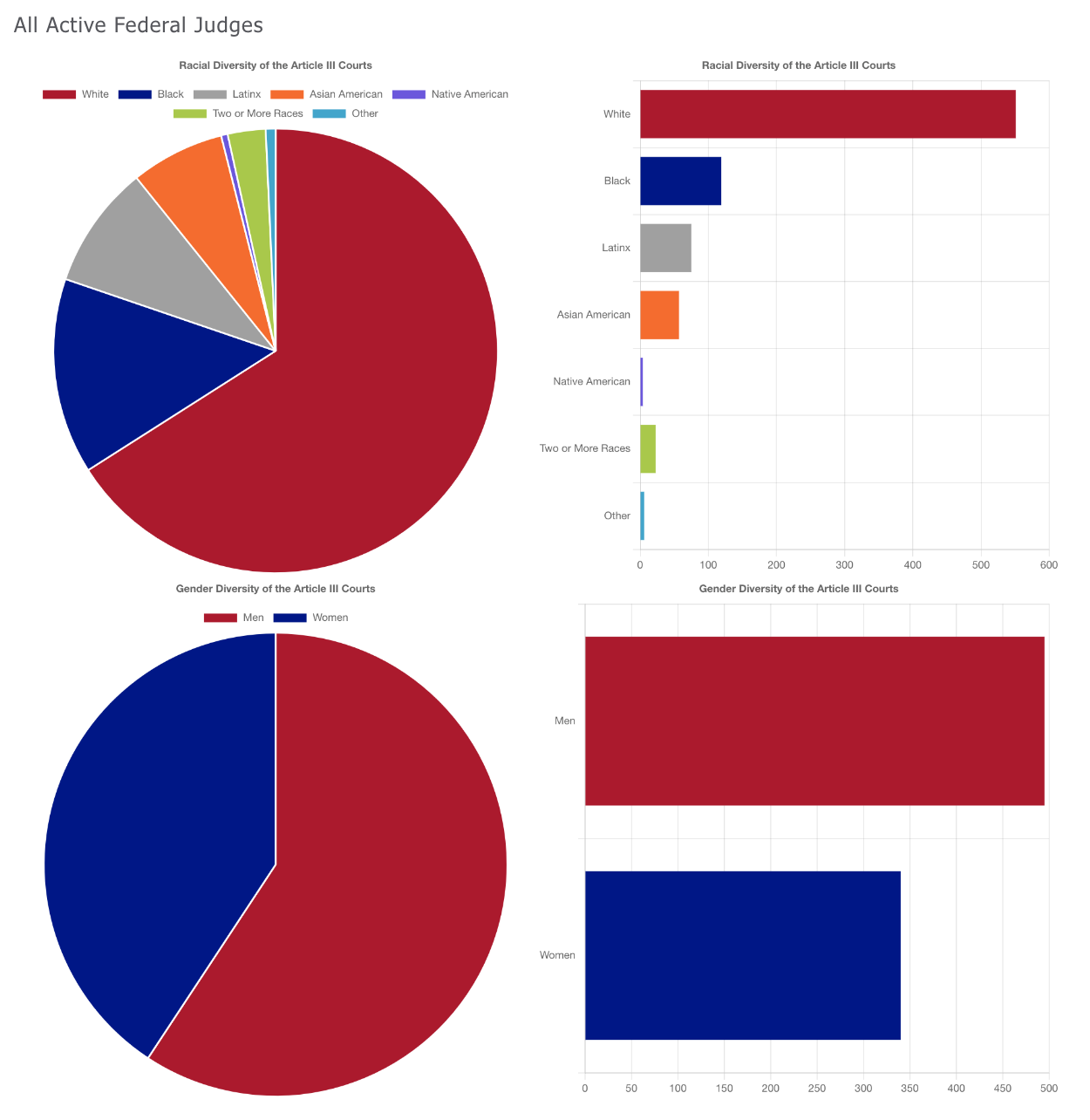
According to recent census bureau data 61.6% of Americans identify as White. Approximately 66.83% of all Federal Judges are White? Half of Americans are female. Approximately what percent of federal judges are female?
Describe how Article III judges compare to America at large in terms of race or gender.
In what way do judges least look like America at large?
45 of 46 presidents have been white. 46 of 46 presidents have been male. Describe the role presidents have in shaping the Article III courts.
When a president nominates someone for the federal courts, according to Article II, Section 2 of the U.S. freaking Constitution, who must approve that nominee?
According to the American Constitution Society, “Courts should look like the people they represent.” Explain whether you agree with that statement.
According to a 2024 Gallup Report only 35% of Americans trusted the judicial branch - an all time low. The judicial branch relies upon the executive branch to enforce any of its rulings. Explain how the low approval of the judiciary could impact its power.
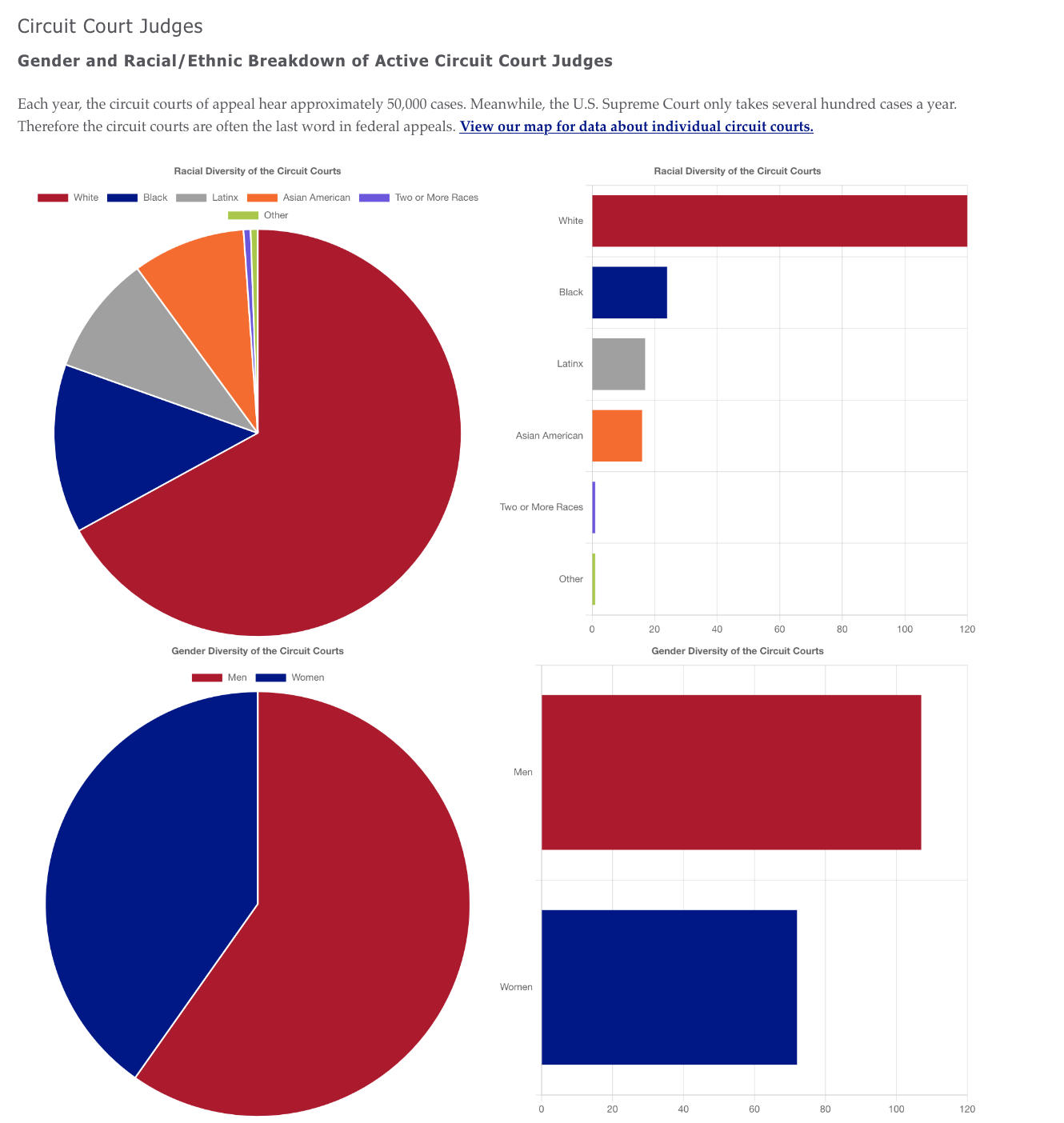
Each year, the circuit courts of appeal hear approximately 50,000 cases. Meanwhile, the U.S. Supreme Court only takes several hundred cases a year. Therefore the appeals courts are often the last word in federal appeals. As of early 2026, the U.S. Supreme Court consists of nine justices (six men, three women) with increased racial diversity, featuring seven white justices, one African American male (Clarence Thomas), one African American female (Ketanji Brown Jackson), and one Latina female (Sonia Sotomayor). The Court is majority Catholic (six), with two Protestants and one Jewish justice. How does the diversity of the appeals courts in the visual below compare to the Supreme Court?
When Judge Deborah A. Batts was confirmed to the U.S. District Court in the Southern District of New York in 1994, she became the first openly LGBTQ+ Article III federal judge in United States history. Until the confirmation of Judge Batts, the federal judiciary did not represent the LGBTQ+ community, leaving many LGBTQ+ Americans distrustful and wary of the federal judiciary. Not only did LGBTQ+ litigants fear bias impacting their cases, LGBTQ+ state court judges, attorneys, legal professionals, and law students did not see a future for themselves in the federal judiciary. For over a decade, Judge Batts remained the only openly LGBTQ+ federal judge until 2011, when Judge Paul Oetken was confirmed to the United States District Court for the Southern District of New York. Today, despite 9.3% of adult Americans identifying as LGBTQ+, only 3% of active federal circuit and district courts judges are openly LGBTQ+. Notably, the United States has never had an openly bisexual, transgender, or nonbinary Article III federal judge. Do you think the demographics of judges matters to people who stand before them?
Write and Discuss
Take ten minutes to write about the question at the top of the page and then discuss with your classmates.
Act on your Learning
Contact President Trump and share your opinion about what kind of judicial nominations he should make.
Get Creative
You are president. Congratulations! What do your judicial appointments look like in terms of diversity?
Learn More*
Check out the interactive graphics about the diversity of Article III courts.