How often do lawmakers try to amend the U.S. Constitution?
Critical Analysis
Find answers to the following questions using the visual above, any links below, your big brain, and your knowledge of American government and politics:
Since 1789, lawmakers in Congress have introduced more than 12,000 measures to amend the Constitution. The vast majority have gone nowhere. According to the visual above how many times have amendments to the Constitution been proposed in the most recent Congressional term?
According to the visual above, in recent years, which party is more likely to try to amend the U.S. Constitution?
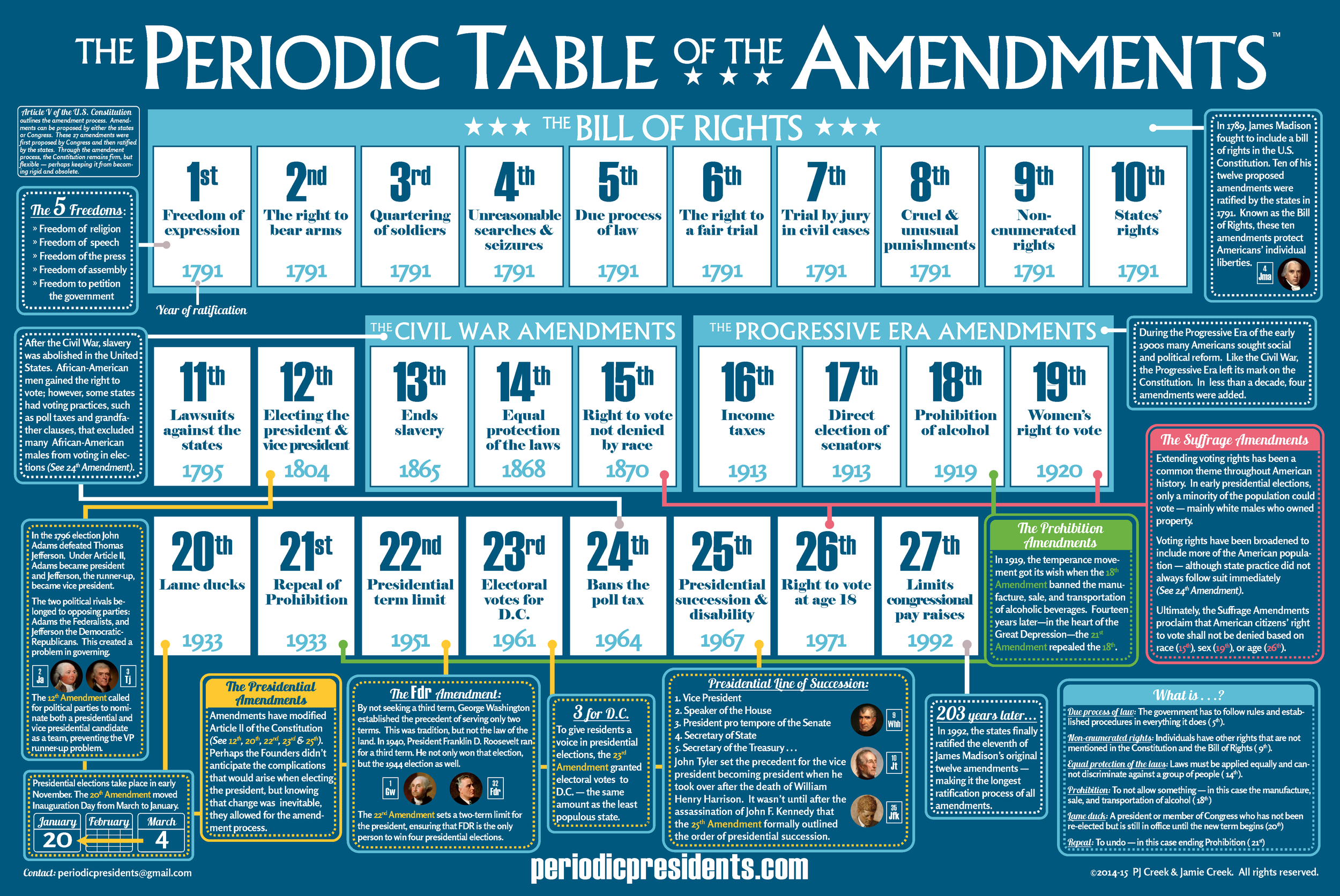
Majorities of Americans support term and age limits on elected officials, limiting spending on political campaigns, and choosing the president by direct popular vote instead of through the Electoral College. But doing so would require amending the Constitution, which takes a two-thirds vote in both houses of Congress and ratification by three-quarters of the states, or 38 out of 50. In today’s fractured polarized political climate, explain whether amending the U.S. constitution is likely.
Only 27 out of over 12,000 proposed Amendments have been ratified. Why is that?
The U.S. Constitution is the second hardest to amend across 101 democracies worldwide, according to a recent Pew Research Center analysis. The only democracy whose constitution is harder to change is the Federated States of Micronesia, a former U.S. trust territory in the South Pacific with about 76,000 inhabitants. Make a claim about whether the amendment process should be more or less difficult.
What does the difficulty of the amendment process say about the Framers of the Constitution’s faith in democracy?
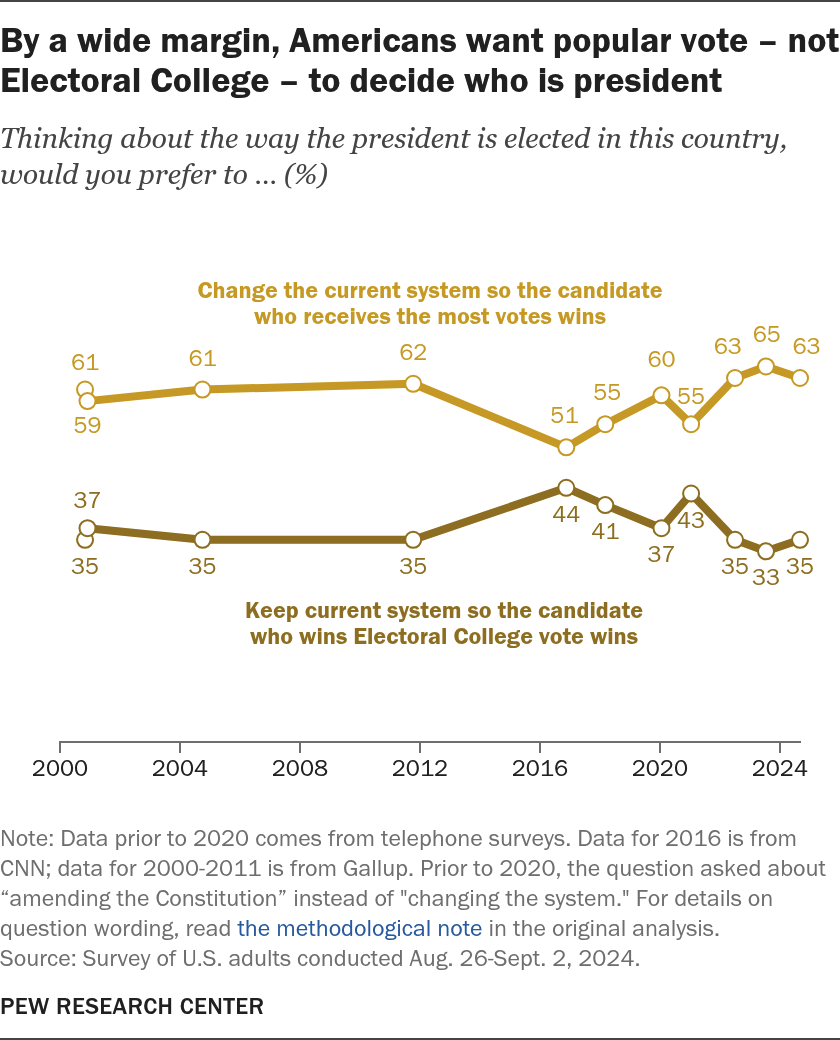
Pew Research Center surveys in recent years have found broad support – often in both political parties – for several ideas that would, if enacted, represent significant changes to the U.S. political system. Those ideas include age limits for politicians, limits on money in politics (supported by 725 of Americans), and the direct election of the president as shown in visual below.* Which of those three proposals would you support?
Rulings from the Supreme Court strongly suggest that any of these changes would require a constitutional amendment. In the 1990s, several states tried to limit how many terms their senators and representatives could serve in Congress. But in a 1995 decision, the Supreme Court said neither the states nor Congress could impose qualifications for congressional service beyond the minimum age, residency and citizenship requirements spelled out in the Constitution itself. The same logic could apply to setting age limits for federal elected officials. How does this illustrate the concept of checks and balances?
If you could Amend the Constitution in one way what would you propose?
Imagine it took only a simple majority of Congress (50%+1) to propose, and only half the states (25) to ratify the Constitution. How would America be different today?
Teaching AP Government is a marathon, and every class period needs a strong start. The Liberty Bell Ringer Membership gives you an archive of 1,000+ ready-to-go bell ringers. But it doesn't stop there. When it's time to mix things up, dig into a growing library of whole-class games your students will actually enjoy. And when May draws near the built-in exam prep has you covered. Cancel at any time. Use promo code SIGNMEUP at checkout to get the first month of our monthly subscription for free!














Write and Discuss
Take ten minutes to write about the question at the top of the page and then discuss with your classmates.
Act on your Learning
Visit the National Constitution Center Website and then try to pass this Bill of Rights Quiz. Share your scores in class or online.
Get Creative
Read about the constitutional amendment process, write a proposal for a new amendment to the constitution, and send it to your congressional representative.
Learning Extension


Get AP Exam Ready with anytime access to our fabulous gamified online exam-prep resources, self-guided workshops, interactive reviews, games, and exclusive content. This comprehensive suite of materials is specifically designed to help students master the content and skills required for success on the AP United States Government and Politics Exam, such as reading comprehension and concept application.