Critical Analysis
Find answers to the following questions using the visual above, your big brain, the information provided and any links below:
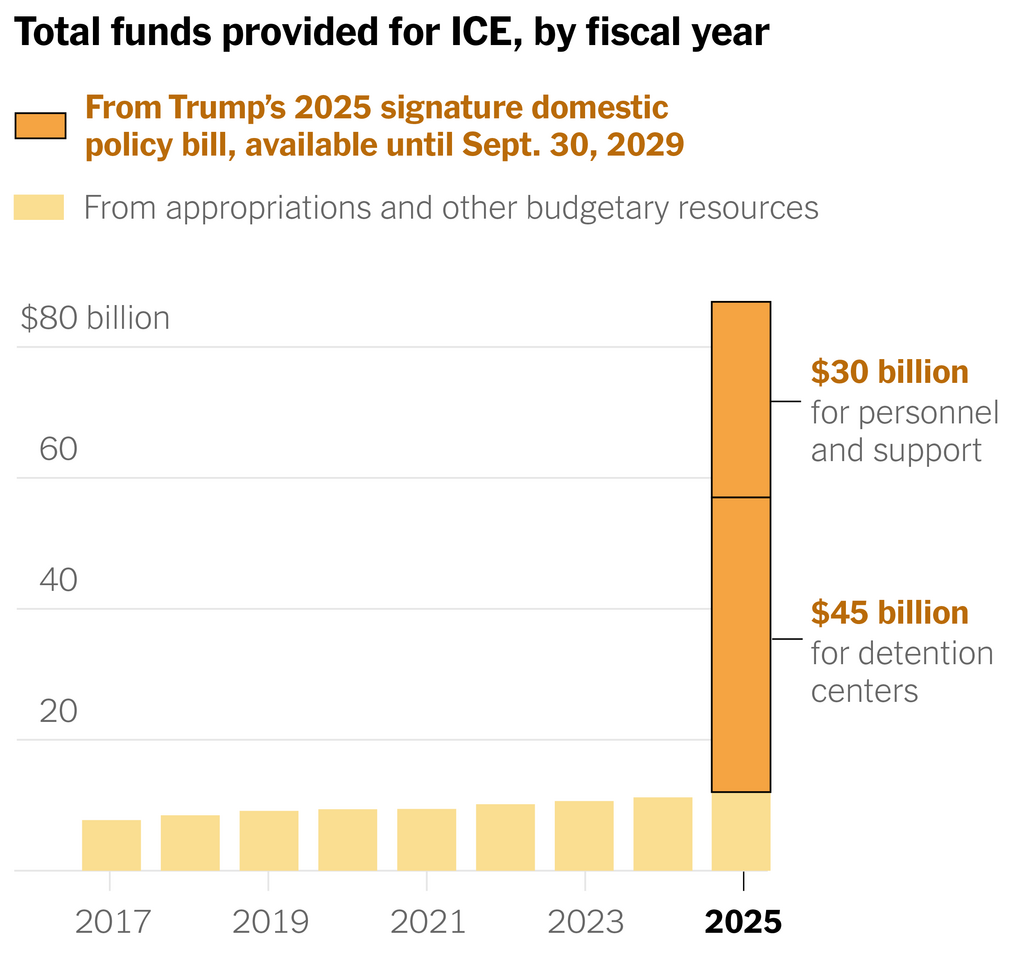
According to the visual above from usaspending.gov, describe the trend in spending from appropriations and other budgetary resources between 2017 and 2025.
According to the visual above from usaspending.gov, approximately how much did the U.S. government spend on ICE (U.S. Immigration and Customs Enforcement) in 2025?
According to the visual above, the largest portion of money in Trump’s 2025 signature domestic policy bill goes to what kind of spending?
How much more money did ICE receive in 2025 than it received in the years 2017-2024 combined?
H.R.1 - One Big Beautiful Bill Act that was enacted this summer made the administration’s priorities clear, with about $162 billion in new funding for border security and immigration enforcement, significantly shifting the Department of Homeland Security’s focus. More than half of the department’s annual budget is projected to fund immigration activities over the next few years, up from 37 percent during the last fiscal year. Why do you think spending on immigration enforcement is increasing and specifically, why do you think so much of that funding is going to ICE?
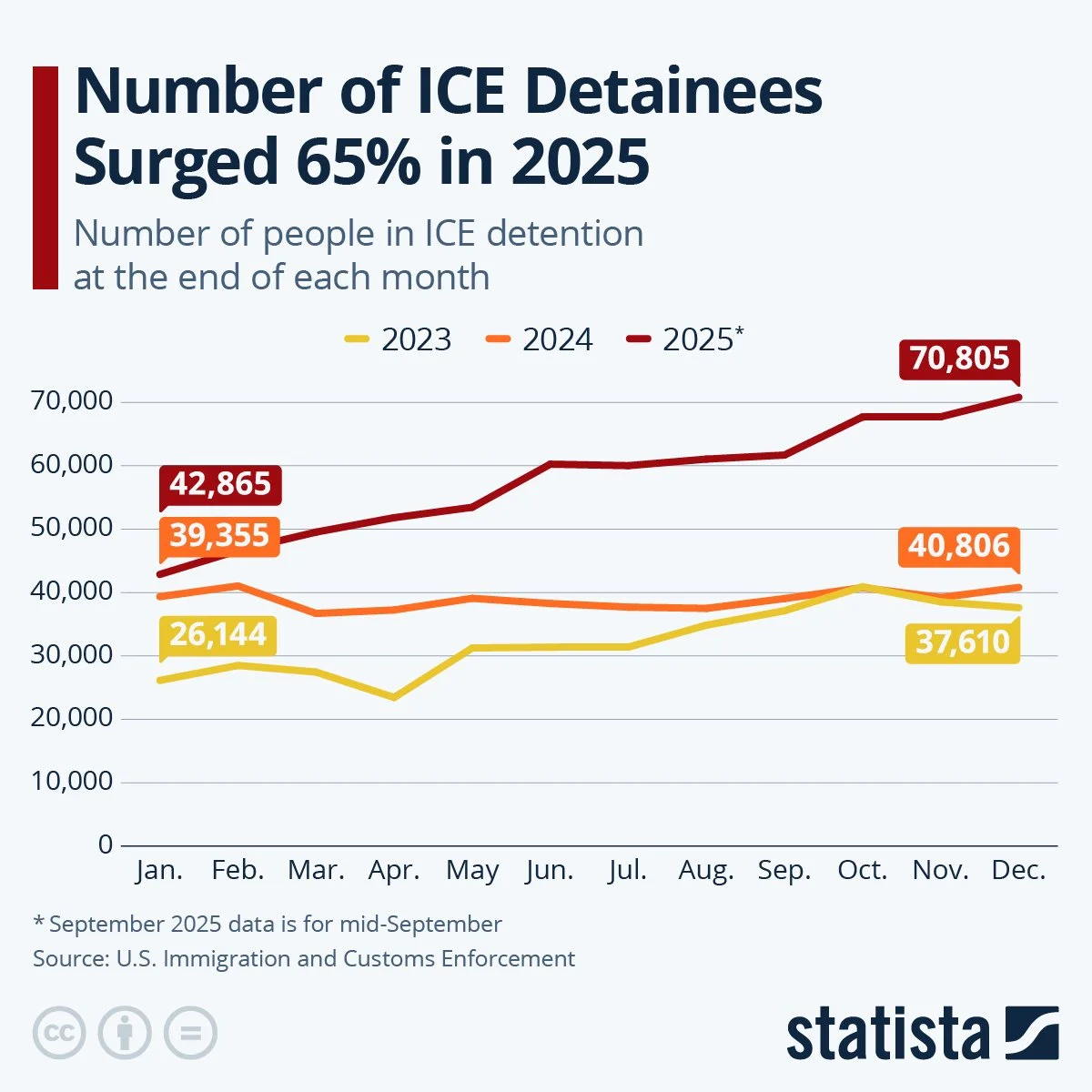
With the huge increase in spending for U.S. Immigration and Custom Enforcement (ICE) its staff is expected to grow by 66 percent, and its detention centers are expected to expand exponentially. This investment makes ICE the nation’s highest-funded law enforcement agency. ICE’s buget is larger than the combined budgets of the Federal Bureau of Investigation (FBI): $10.8 billion; Drug Enforcement Agency (D.E.A): $3.4 billion; Bureau of Alcohol, Tobacco, Firearms and Explosives (ATF): $1.952 billion; U.S. Marshals Service (USMS): $1.9 billion; and the The U.S. Secret Service: $3.2 billion. How would you rank these agencies in terms of funding priorities?
ICE was created in 2003 through a merger of the investigative and interior enforcement elements of the former U.S. Customs Service and the Immigration and Naturalization Service. ICE now has more than 20,000 law enforcement and support personnel in more than 400 offices in the United States and around the world. Public criticism is mounting over federal immigration tactics in Minneapolis, which escalated in recent days following the fatal shooting of 37-year-old ICU nurse Alex Pretti. His killing comes just days after ICE agent Jonathan Ross fatally shot Renee Nicole Good, also 37. How do you think public opinion will shape the future budget for ICE?
How does the fact that the Congress passed H.R.1 - One Big Beautiful Bill Act and the President is in charge of the Department of Homeland Security illustrate the concept of separation of powers?
The military budget of the United States is the world’s largest, nearly tripling that of China—the next biggest spender—while U.S. Immigration and Customs Enforcement’s (ICE) multibillion-dollar annual bankroll is higher than the entire defense coffers of some countries. ICE’s budget exceeds several countries’ entire defense budgets, including those of Denmark, Romania, Belgium, Greece and Morocco, all of which are below $10 billion annually, according to the Stockholm International Peace Research Institute (SIPRI). ICE's budget is closer to the size of the military budget of the following countries: Turkey, Spain, the Nethernlands, Algeria, Brazil, and Canada. If Congress did not like the way ICE was conducting its business, what could they do to change it?
According to immigration enforcement specialist, Austin Kocher, “Just 2.6% of those arrested by ICE this year had any prior offense serious enough for ICE to place them in the high-risk category. That means more than 97% of the people swept up in this high-profile, taxpayer-funded enforcement operation were not the ‘worst of the worst,’ despite repeated claims to the contrary.” Federal data shows that many immigrants being arrested do not have criminal records in the United States. Fewer than 40 percent of people detained by Immigration and Customs Enforcement have a criminal conviction. Roughly 8 percent of those arrested had been convicted of a violent crime, while about 9 percent had a traffic conviction, the analysis found. If you were a member of the Congress would you vote to increase or decrease ICE funding?
Write and Discuss
Take ten minutes to write about the question at the top of the page and then discuss with your classmates.
Act on your Learning
Contact your members of Congress and let them know what you think about ICE funding.
Get Creative
Think of your favorite car. How much would it cost to buy a new one? How many of those cars could you buy if you had ICE’s budget for detention centers?
Learn more*
We hope you enjoyed today’s lesson. Join our archive for access to this and over 1000 other great GoPo lessons.
Teaching AP Government is a marathon, and every class period needs a strong start. The Liberty Bell Ringer Membership gives you an archive of 1,000+ ready-to-go bell ringers. But it doesn't stop there. When it's time to mix things up, dig into a growing library of whole-class games your students will actually enjoy. And when May draws near the built-in exam prep has you covered. Cancel at any time. Use promo code SIGNMEUP at checkout to get the first month of our monthly subscription for free!