Critical Analysis
Find answers to the following questions using the visual above, any links below, your big brain, and your knowledge of American government and politics:
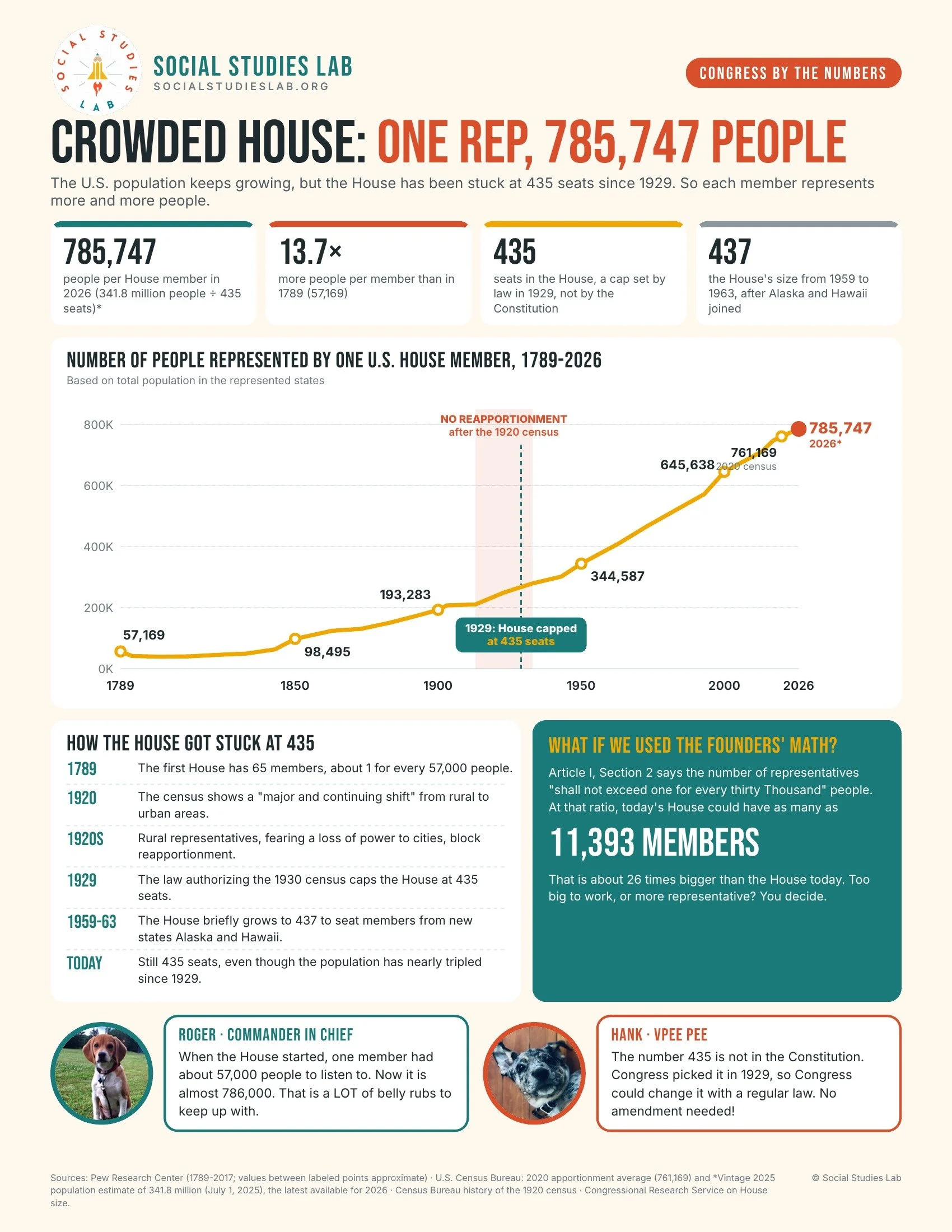
According to the data from the chart above, about how many people does the average U.S. House Member represents today?
In 1789 one House member represented about 57,169 people; in 2026 it’s 785,747. Calculate the percent increase. Then explain what that change likely means for how well a member can know and respond to constituents.
After the 1920 census, rural representatives blocked reapportionment because they feared losing power to cities. Which constitutional principle did that violate? Connect it to Baker v. Carr (1962) and the idea of “one person, one vote.”
In Rhode Island each U.S. House member represent 529,820 people. In Montana each House member represents 1,050,493 people (see chart below*). Explain why the number of people represented by each House Member is not exactly the same nation wide?
The 435 cap comes from a 1929 law, not the Constitution. What would it take to change the size of the House? Why might current members of Congress have little reason to do it?
How does the size of American congressional districts compare with other countries?* (see groovy chart below)
There is currently a cap on the membership of the U.S. House of Representatives at 435. Do you think that cap is a good idea?
A House at one member per 30,000 people would have 11,393 members. Give one argument that a much larger House would improve representation and one that it would hurt how the House works.
The number of electoral votes each state gets equals its House seats plus its two senators. How does freezing the House at 435 affect the Electoral College and the balance between large and small states? Is the promise of equal representation fulfilled?
The Wyoming Rule (see figure 1 below*) is a proposal to expand the size of the United States House of Representatives so that each member represents roughly the same number of people as the population of the least populous state, which is currently Wyoming. The total resident population of the United States is divided by the population of the smallest state (Wyoming) to determine the new, larger total number of seats in the House. Those seats are then distributed among the states based on their individual populations, ensuring every state still receives at least one representative under the U.S. Constitution. The size of the House has been capped at 435 members since 1929. Based on the 2020 U.S. Census data, implementing the Wyoming Rule would expand the House to approximately 573 to 574 seats (depending on whether total or apportionment population is used). More populous states like California, Texas, and Florida would gain a significant number of additional representatives and electoral votes. States with small populations like Wyoming would generally retain a single at-large seat, while some slightly larger single-seat states (such as Delaware and South Dakota) would pick up a second seat. Proponents argue the rule reduces severe representation imbalances where members in fast-growing, large states represent over 750,000+ constituents. Explain whether you support the Wyoming Rule.
Write and Discuss
Take ten minutes to write about the question at the top of the page and then discuss with your classmates.
Act on your Learning
Contact your U.S. House member, let them know what you think about the House’s 435 member cap, and ask them what they plan to do about it. Share your correspondence in class, online, or in a classy oil painting!!!!
Like today’s government lesson? Subscribe for access to a searchable archive of over 1000 lessons and much more. Join now and the first month is free! Cancel at any time.
Teaching AP Government is a marathon, and every class period needs a strong start. The Liberty Bell Ringer Membership gives you an archive of 1,000+ ready-to-go bell ringers. But it doesn't stop there. When it's time to mix things up, dig into a growing library of whole-class games your students will actually enjoy. And when May draws near the built-in exam prep has you covered. Cancel at any time. Use promo code SIGNMEUP at checkout to get the first month of our monthly subscription for free!
Get Creative
If the House of Representatives was a plant, what type of plant would it be?
Learn More*
Read the Pew Research Center’s report about U.S. House district size, U.S. population keeps growing, but House of Representatives is same size as in Taft era. And check out these great visuals on House size from 538.com
Breaking News
The first Congress (1789-91) had 65 House members.
A 1929 law authorizing that census also capped the size of the House at 435. And there it has remained, except for a brief period from 1959 to 1963 when the chamber temporarily added two members to represent the newly admitted states of Alaska and Hawaii.
One proposal to add seats to the House is the so-called “Wyoming Rule,” which would make the population of the smallest state (currently Wyoming) the basis for the representation ratio. Depending on which variant of that rule were adopted, the House would have had 545 to 547 members following the 2010 census.