Critical Analysis
Find answers to the following questions using the visual above, any links below, your big brain, and your knowledge of American government and politics:
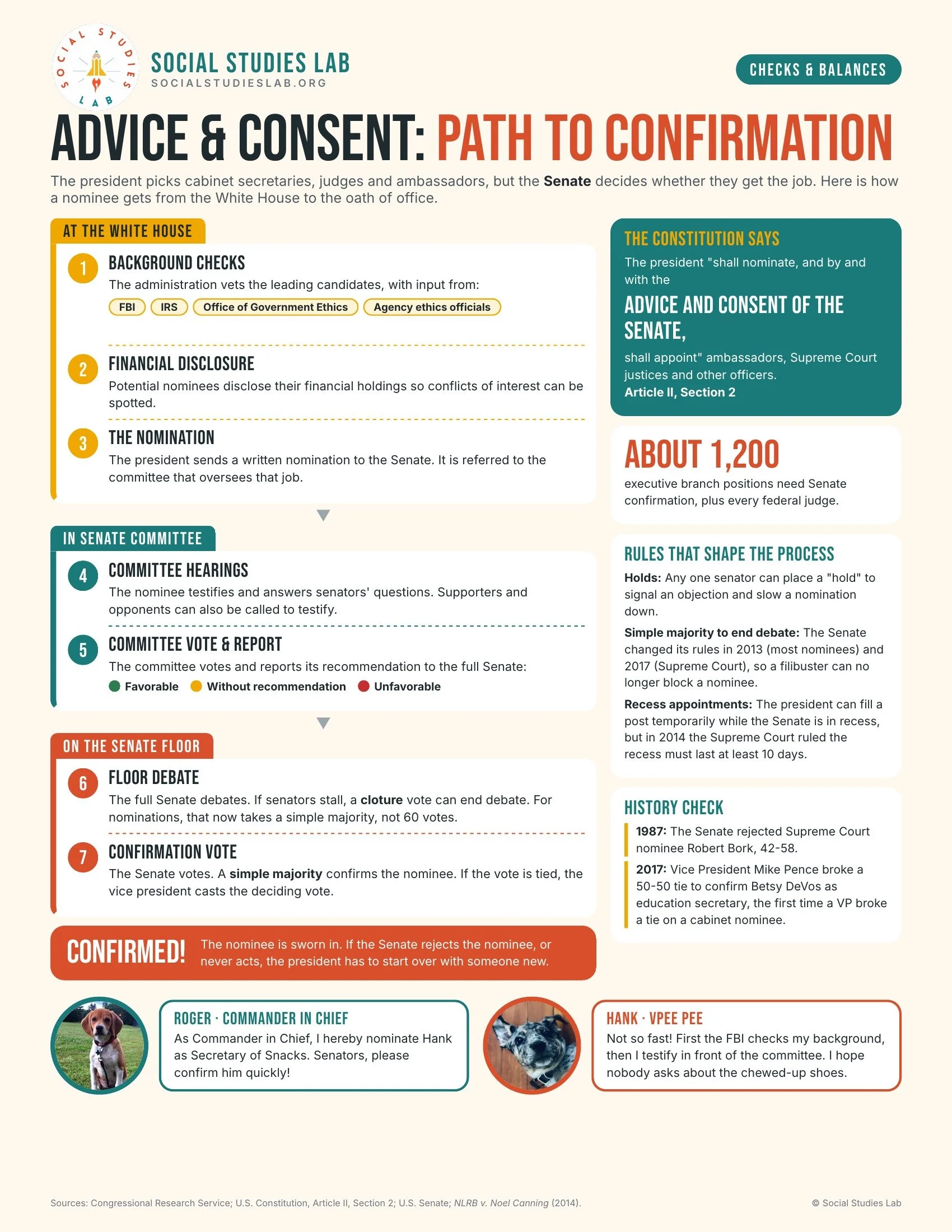
According to the visual above, what different government agencies are involved in background checks for presidential nominees?
Divided government is a political situation in which control of the executive branch and the legislative branch is split between different political parties. Explain how a divided government with the U.S. Senate majority controlled by a different party from the President’s would impacts the confirmation process?
Article II, Section ii of the U.S. Constitution lays out the rules of nomination and confirmation: He shall nominate, and by and with the Advice and Consent of the Senate, shall appoint Ambassadors, other public Ministers and Consuls, Judges of the supreme Court, and all other Officers of the United States. The Appointments Clause allows the President to make nominations for appointed positions like cabinet officers, but the Senate controls the process, including the rules that allow a nomination vote to get to the full Senate floor. What concept of American government and politics is illustrated by the role of both the President and the Senate in presidential nominee approvals?
In many democratic political systems, such as a parliamentary system, because the chief executive (Prime Minister) controls a majority of the legislature they are able to immediately name and implement a cabinet. What would James - Ambition must be made to counteract ambition - Madison, author of Federalist No. 51, think about a system where the chief executive (Prime Minister) has unchecked power?
Whenever a U.S. president nominates someone to fill a position in his administration — whether it’s just after the election or another time during his term in office — that nominee’s appointment must be confirmed by the U.S. Senate. Somewhere between 1,200 and 1,400 government positions require confirmation. This process is time consuming. Do you think the U.S. government and political system would be better if we removed Senate confirmation hearings?
The Senate, scrutinizes and approves candidates for high level government positions nominated by the president in a process described in the Constitution as “advice and consent.” Senatorial courtesy is an informal practice that has influenced the appointment of federal district court judges since the 1840s. While the president nominates these judges, he is expected to consult with the senators from the respective state, particularly if they belong to the same political party. In cases where both state senators align with the president's party, the senior senator wields significant influence, holding the power to veto nominations. The process traditionally involved a "blue slip" system, where senators could express their approval or disapproval of a nominee, with a lack of response effectively functioning as a veto. Explain whether Senatorial Courtesy gives too much power to one person to block the will of the president.
A Senate hold is an informal practice by which a senator informs Senate leadership that he or she does not wish a particular measure or nomination to reach the floor for consideration. A hold is how a senator informally signals objection to a bill or nomination. The holds don’t prevent nominees from being confirmed, but they force extra steps in a Senate that already moves at a leisurely pace. The backup burns through time on the Senate calendar and forces Senate Majority Leader John Thune (R) of South Dakota to make tough choices about what will see a vote. In general, do you think a single Senator should have enough power to thwart the will of the president - the only democratically elected official representing all the people?
The Framers gave the president the power to nominate but required the “advice and consent” of the Senate. Which constitutional principle does this show, and how does each step on the infographic give a different person or group a chance to check the president’s choice?
Before 2013, opponents could block most nominees with a filibuster, which took 60 votes to break. Now a simple majority can end debate. How might this rule change affect the kinds of people presidents nominate, and how much power the minority party has?
Starting January 3, 2027 the president and the Senate majority will be from different parties. Pick one step on the infographic where you think the conflict would be biggest. Explain what the Senate could do there to slow down or stop a nominee, and what the president could do in response.
Write and Discuss
Take ten minutes to write about the question at the top of the page and then discuss with your classmates.
Act on your Learning
Contact your U.S. Senators and let them know what you think about senatorial courtesy.
Get Creative
How would you alter the senate nomination process to make it easier for someone like Bad Bunny to be nominated and approved by the Senate?