Critical Analysis
Find answers to the following questions using the visual above, any links below, your big brain, and your knowledge of American government and politics:
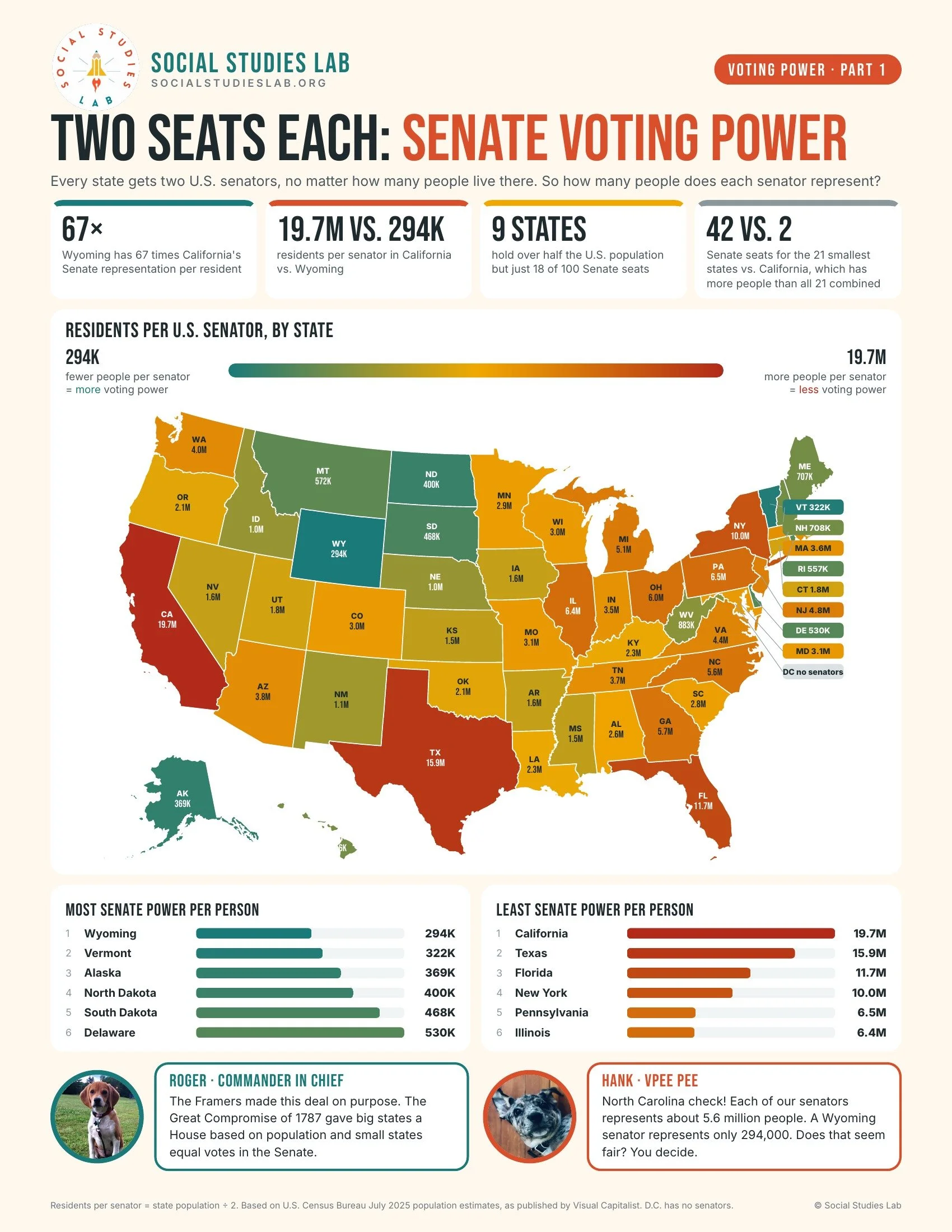
Which state has the most Senate voting power per person and which has the least? Use the map to find two other states with very different populations that still have the same number of senators.
California has more people than the 21 smallest states combined, yet those states hold 42 Senate seats to California’s 2. Why did the Framers agree to the Great Compromise, and does the reasoning still hold today?
A North Carolina senator represents about 5.6 million people, while a Wyoming senator represents about 294,000. How might that difference affect how often each senator can meet with constituents, or whose concerns get attention?
Nine states hold more than half the U.S. population but only 18 Senate seats. What could happen when a majority of senators represents a minority of Americans? Give an example of a vote where this could matter, such as confirming a Supreme Court justice.
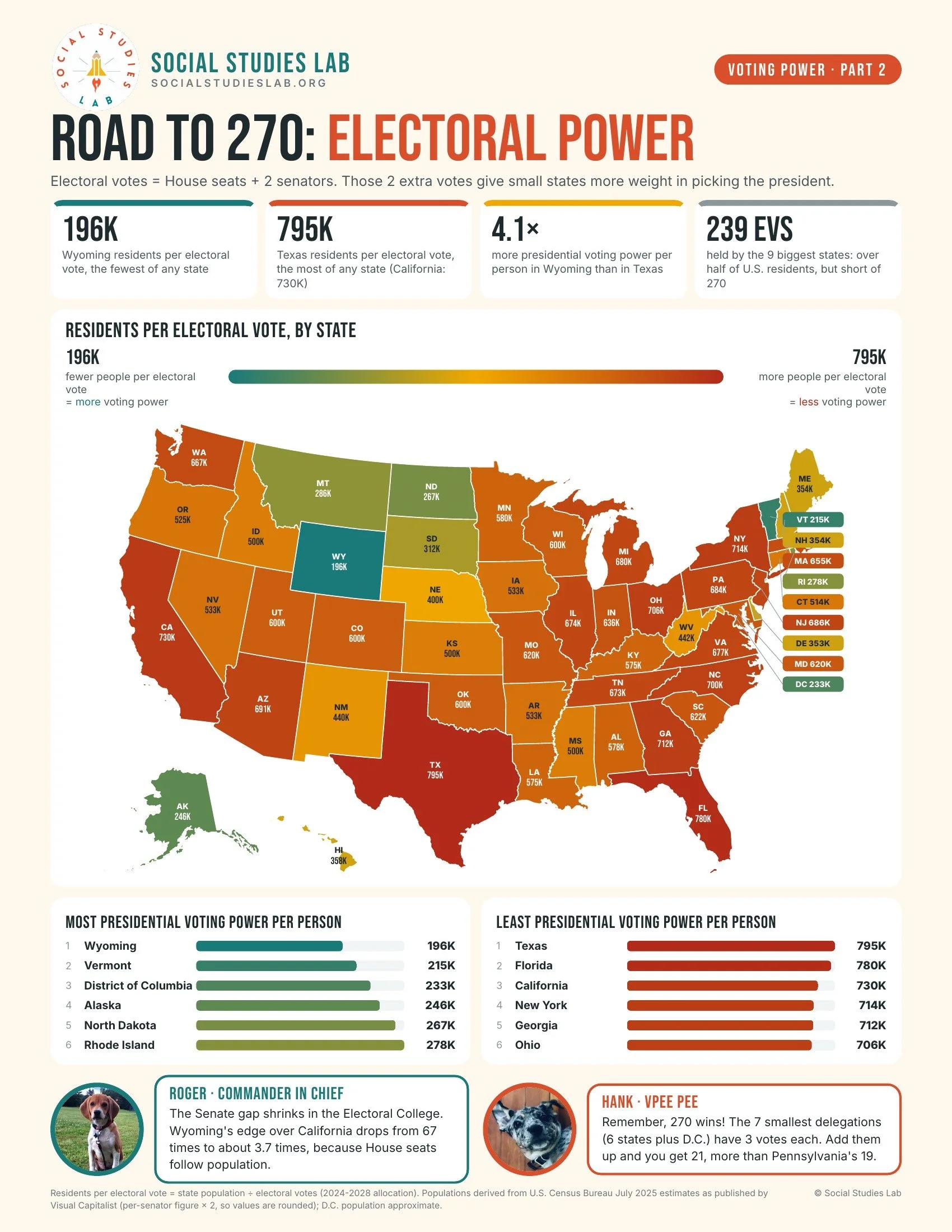
In the Senate, Wyoming has 67 times California’s power per resident, but in the Electoral College the gap is about 3.7 times. Using what you know about how electoral votes are calculated, explain why the gap shrinks.
The 9 biggest states hold over half the population but only 239 electoral votes, short of 270. Is that a feature that protects smaller states or a flaw that weakens majority rule?
Texas has the least presidential voting power per person, yet candidates often ignore it because it’s not usually a swing state. Which matters more for a voter’s real influence on a presidential race: residents per electoral vote, or whether the state is competitive? Explain.
D.C. has about 700,000 residents, more than Wyoming or Vermont, but no senators and no voting member of the House. Should D.C. have representation in Congress? What would it take: statehood, a constitutional amendment, or something else?
Article V says no state can lose its equal vote in the Senate without its own consent. Why would the Framers protect equal Senate representation more strongly than almost any other part of the Constitution? What does that tell you about how hard it would be to change?
Some people propose fixes such as the National Popular Vote Interstate Compact, adding more House seats, or splitting large states. Pick one. How would it change the numbers on these maps, and who would support or oppose it?
Write and Discuss
Take ten minutes to write about the question at the top of the page and then discuss with your classmates.
Act on your Learning
How much voting power do you really have? Find your state’s residents per senator and per electoral vote on these maps. Then use Census QuickFacts to find how many people your state legislators represent. Make a one-page “My Voting Power Report Card” comparing the three, and send one finding to one of your state’s senator’s office or your local paper as a short letter asking whether they think representation is fair.
Get Creative
If you were at the Constitutional Convention in 1787 and could see these 2025 numbers, how would you redesign the Senate or the Electoral College? Write a short “Delegate’s Proposal” from the point of view of a big-state or small-state delegate. Include a new formula for seats or electoral votes, a redrawn version of this map under your plan, and a 60-second speech persuading the other delegates to adopt it.