Critical Analysis
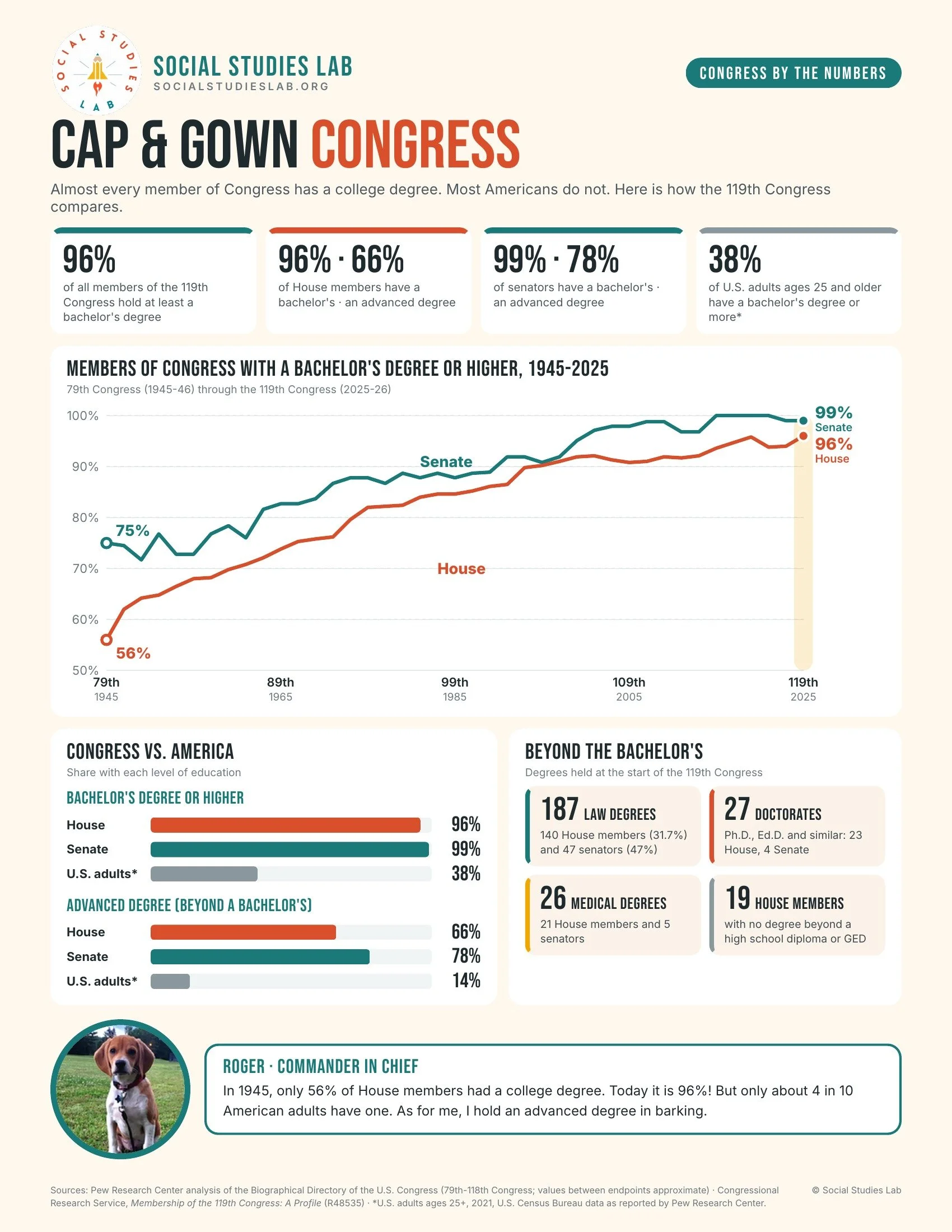
Find answers to the following questions using the visual above, any links below, your big brain, and your knowledge of American government and politics:
According to the data from the visual above, does the U.S. House or the U.S. Senate have a higher percentage of members who hold bachelor’s degrees?
According to the data from the visual above, in the 79th Congress, what percentage of Senators held bachelor’s degrees.
According to the data from the visual above, describe one trend in education levels in the U.S. Congress since 1945.
Not every current lawmaker went to college. Twenty-two members of the House have only a high school diploma, according to the Congressional Research Service. That’s 6 percent of lawmakers — a significant reduction from the 1961-1962 legislative session, when nearly a quarter of lawmakers had only high school diplomas. In the Senate, Republican Markwayne Mullin of Oklahoma was the lone senator without at least a bachelor’s degree before he was elevated to the head of the Department of Homeland Security. Sen. Rand Paul, a Kentucky Republican, earned a doctorate in medicine from Duke University Medical School but does not hold a bachelor’s. Explain whether you would vote for a congressional candidate who did NOT have a college degree.
At the other end of the educational spectrum, about a third of House members and half of senators hold law degrees, CRS found. Our analysis shows more than 60 percent of those with a juris doctor (law) degree are Democrats, while those with a master of business administration are more likely to be Republican. Similarly, more than two-thirds of the legislators with doctorates are Democrats, but an even bigger majority of those in Congress who have medical degrees are Republicans. In the first U.S. congress, what percentage of members had college degrees?* (By the way, I don’t know the answer to this question. I am truly curious. If you put the answer in the comments section below I will be grateful.)
Census Bureau data shows that most Americans over the age of 25 don’t have a four-year degree. Based on the data from the visual below*, describe the gap in educational attainment between the U.S. Congress and the general U.S. population.
Members of Congress are about 2.5 times as likely as American adults to hold a bachelor’s degree (96% vs. 38%). Does that make Congress better at making laws, or does it mean Congress understands fewer Americans’ lives?
47% of senators hold law degrees. Why might law school be such a common path to Congress? Which skills from law help a lawmaker, and whose perspectives might be missing?
The Constitution sets only three qualifications for the House: age, citizenship and residency. It requires no education. Why might the Framers have left education out? Should a college degree ever be required? Explain.
19 House members have no degree beyond high school. Using this chart and what you know about the cost of campaigns, explain how education, money and networks might shape who can run for Congress. Is the promise of representation fulfilled?
Write and Discuss
Take ten minutes to write about the question at the top of the page and then discuss with your classmates.
Act on your Learning
Look up the education of your state’s two senators and House member in the Biographical Directory of the U.S. Congress (bioguide.congress.gov). They compare those degrees with the education levels in their county using Census QuickFacts. Then they write a short letter to one of those members asking how their education shapes the way they represent voters who did not go to college, and share any replies with the class.
Get Creative
Design a yearbook page for a fictional freshman member of Congress who took a different path, such as a nurse, an electrician, a veteran, a small-business owner or a farmer. The page includes the member’s “senior quote,” their “most likely to…” award, and three bills they would introduce based on their life experience. Hang the pages as a gallery walk, then vote on which new member would bring the most missing perspective to Capitol Hill.
Learning Extension
Check out the Pew Research Center survey of education in the 118th Congress.


Note: this data is from the 117th Congress.

Note: this data is from the 117th Congress.