Critical Analysis
Find answers to the following questions using the visual above, any links below, your big brain, and your knowledge of American government and politics:
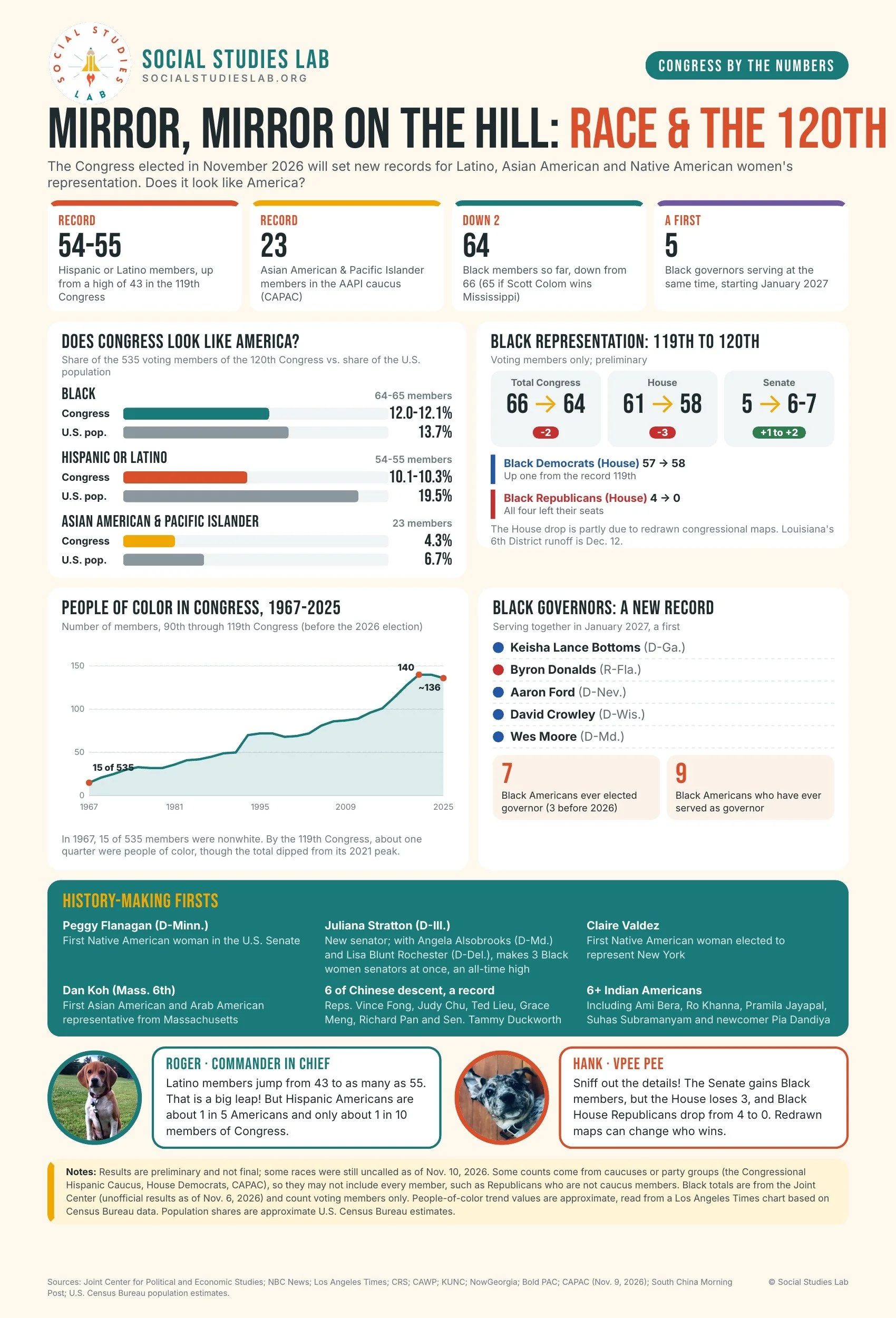
In 1967, 15 of 535 members were people of color. By 2021 it was 140. Describe the trend and identify one big jump on the chart. What historical events or laws might explain it?
For each racial group in the visual above, find the gap between its share of Congress and its share of the U.S. population. Which group is most underrepresented? Which is closest to its share?
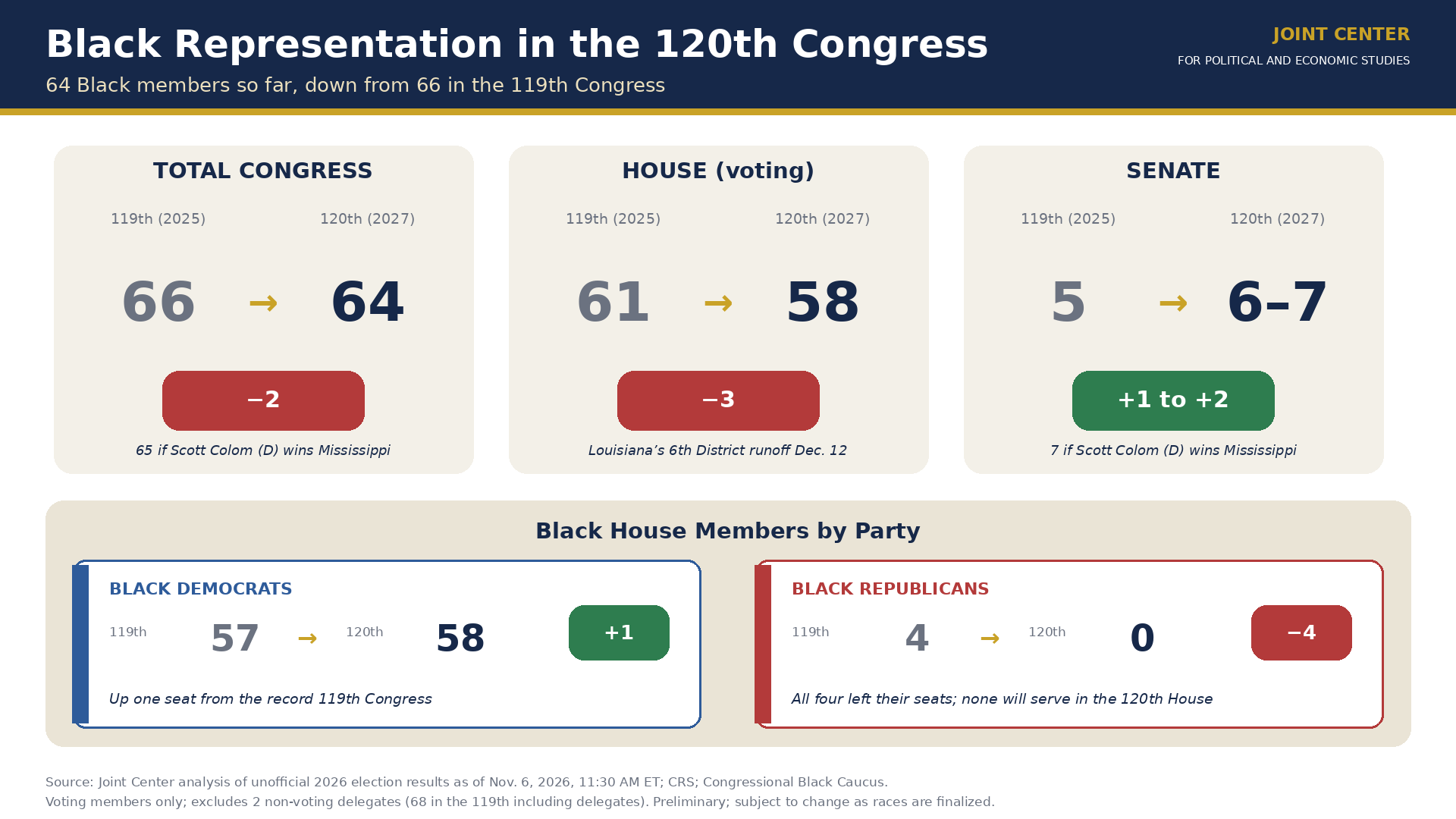
In the most recent election, Black House membership fell from 61 to 58, partly because of redrawn district maps. How can redistricting change who wins? Connect your answer to the Voting Rights Act and majority-minority districts.
Black representation went up in the Senate (5 to 6–7) but down in the House. Senators run statewide while House members run in districts. Why might that difference matter?
Peggy Flanagan will be the first Native American woman in the U.S. Senate, in 2027. Why do you think it took more than 235 years? What does a “first” mean to the people it represents?
Does a member need to share your racial or ethnic background to represent you well?
For the first time, five Black governors will serve at once. Why might governorships matter as a pipeline to national office, such as the Senate or the presidency?
Several counts come from caucuses or party groups, and the results aren’t final. Why could different sources give different numbers for the same Congress? What should you check before citing a statistic?
Isabel Wilkerson writes that says that because American will soon be minority-majority (more non Caucasian-Americans, than Caucasian-Americans) that the U.S. will have to chose between Whiteness and Democracy. Explain whether you agree with Wilkerson’s claim.
Based on current trends, what year do you think the Congress will first be minority-majority; or do you think this will never happen?
Write and Discuss
Take ten minutes to write about the question at the top of the page and then discuss with your classmates.
Act on your Learning
Examine the racial breakdown of your state and your state’s congressional delegation. Share the results in class or online.
Get Creative
Each student picks one history-making member of the 120th Congress, or a historical first such as Shirley Chisholm, Hiram Revels or Patsy Mink. They create a museum-style placard with a portrait drawing, three key facts, a quote, and a “Why this first matters” paragraph. The class hangs the placards as a gallery walk, and students leave sticky-note responses connecting each figure to the data on the infographic.