Are most of the people ICE arrests criminals?
Critical Analysis
Find answers to the following questions using the visual above, any links below, your big brain, and your knowledge of American government and politics:
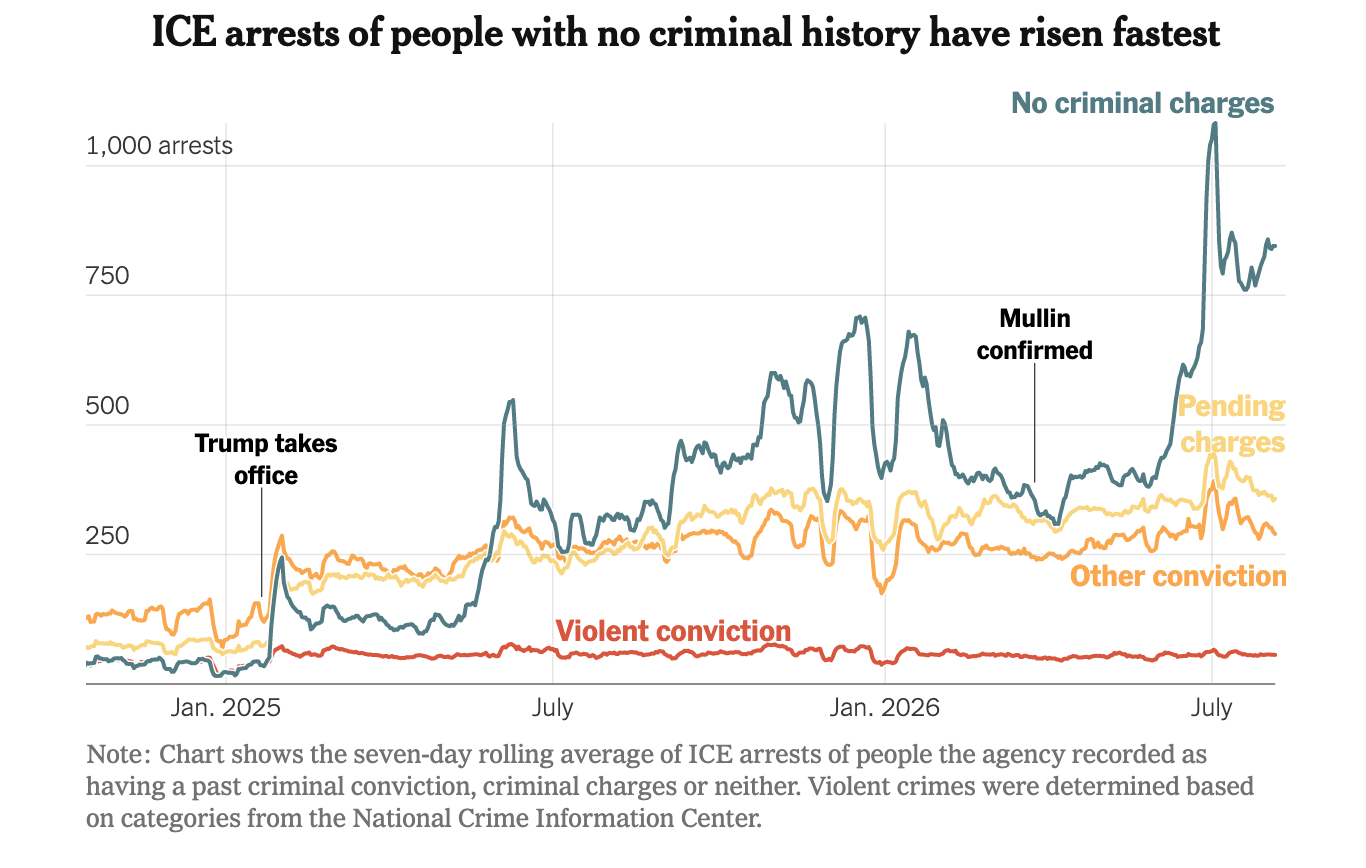
A surge in immigration arrests this summer has swept up thousands of people who had not previously been the focus of President Trump’s mass deportation campaign. They included people married to U.S. citizens, people who had entered legally and were pursuing an asylum claim, and others with a temporary legal status that the administration pushed to revoke. According to the visual above, as of July 2026, approximately what percent of ICE arrests were of people with no criminal charges?
Overall, immigration arrests rose to record highs with 43,000 ICE arrests in June and 49,000 in July, getting closer than ever to the Trump administration’s goal of 2000 a day. Two fatal shootings involving Immigration and Customs Enforcement agents, in Texas and Maine, drew outrage but did not meaningfully slow the pace of arrests. According to the visual above, as of July 2026, approximately what percent of ICE arrests were of people with convictions for violent crimes?
What has happened to the total number of ICE arrests since Donald Trump became president in January 2025?
President Donald Trump has said that ICE would be arresting “the worst of the worst.” What is one consequence of the record number of ICE arrests?.
Do you think it is wise to spend so much money arresting and deporting people who do not have any criminal record?
The ICE budget has seen a massive increase due to recent legislation (Big Beautiful Bill), with a $75 billion allocation over four years, averaging $18.7 billion annually, including $10 billion already appropriated for fiscal year 2025. This legislation significantly increases funding for detention facilities, enforcement operations, and hiring new ICE officers. A large portion of the new funding, around $45 billion over four years, is specifically for increasing immigration detention capacity to potentially hold over 100,000 people annually. Some people refer to this as the deportation-industrial complex (ask your teacher what that means). ICE funding now significantly outpaces other federal law enforcement agencies, with estimates showing its total budget exceeding the FBI, DEA, ATF, US Marshals, and Bureau of Prisons combined, and more than the entire federal prison system. This unprecedented increase in funding is expected to lead to a rapid expansion of deportation and detention capacity, dwarfing prior budgets and making it the highest-funded law enforcement agency in U.S. history. If you were in charge of the budget how would you fund ICE relative to the FBI, DEA, ATF, US Marshals, and Bureau of Prisons
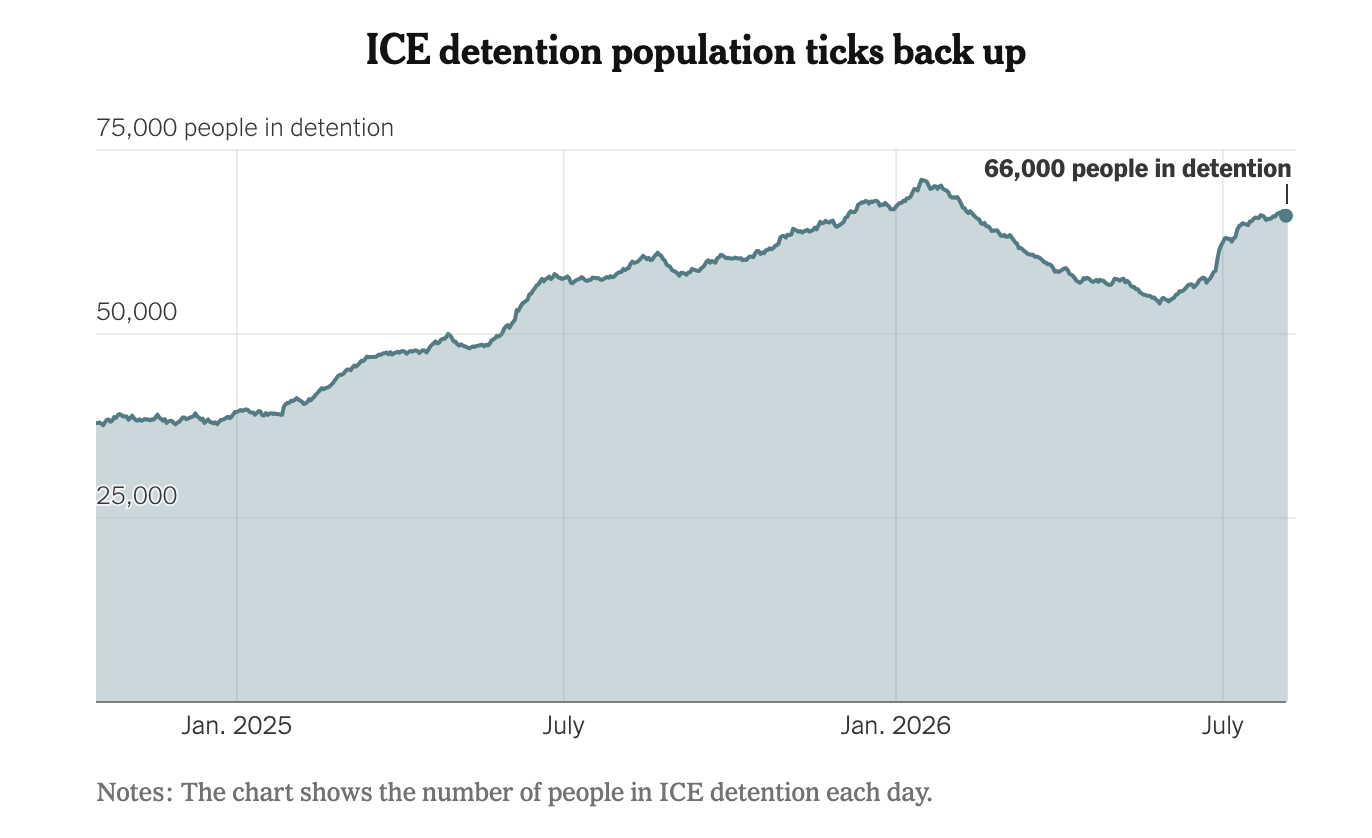
The Trump administration, aiming to deport 1 million undocumented immigrants a year, has directed ICE to conduct immigration raids throughout the country. In some states, like Nevada, arrests have jumped 300%. Taxpayer dollars are used to fund ICE operations. ICE spent, on average, $187.48 for each adult, per bed, each day in the 2023 fiscal year, according to documents from ICE. Meanwhile, the costs of actually removing immigrants will cost billions more. Legal processing, which entails an administrative proceeding in front of an immigration judge, cost the Executive Office for Immigration Review (the agency that oversees the immigration system) an estimated $1,720 per case in 2023, according to the American Immigration Council. According to the visual below there are currently approximately 66,000 people in ICE detention, which amounts to $12 million a day.
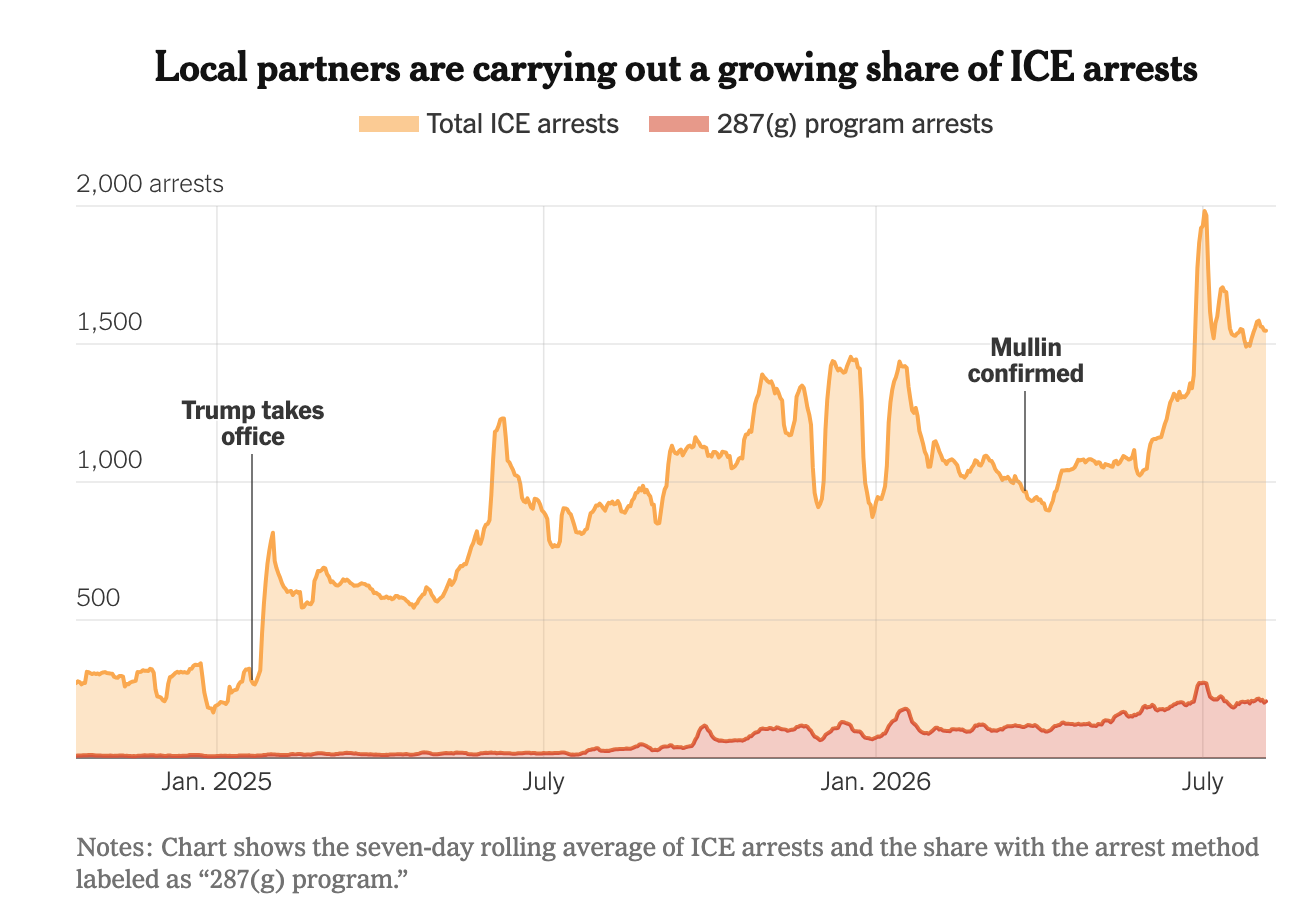
When President Trump returned to office in January 2025, almost all immigration arrests were carried out by ICE. Since 2025, a rising percentage of arrests have come from 287 (g) program agencies - a federal partnership that allows U.S. Immigration and Customs Enforcement (ICE) to delegate specific immigration enforcement authority to state, local, and tribal law enforcement officers. How does this illustrate the concept of federalism?
ICE officer Christian Castro was charged in Minnesota with second-degree assault and falsely reporting a crime for allegedly shooting a Venezuelan man in the leg during a January operation in Minneapolis. Castro was arrested in southern Texas in late May. Because he did not agree to return voluntarily, Minnesota Governor Tim Walz requested his extradition - the formal legal process where one government surrenders a suspected or convicted criminal to another jurisdiction to face trial or punishment, as is practiced in all states. Texas Governor Greg Abbott declined to immediately sign the extradition warrant, stating his office needed more time to investigate whether Castro legally qualified as a "fugitive" since ICE assigned him back to Texas after the shooting rather than him actively fleeing. This week, a federal judge ruled that Texas is not required to immediately extradite a U.S. Immigration and Customs Enforcement (ICE) officer facing criminal charges in Minnesota. How does this ruling illustrate the concept of checks and balances?
The label “unauthorized immigrants” captures a complex array of statuses, including immigrants who entered the U.S. legally. While the label is not perfect, it groups together immigrants living in the country with impermanent, precarious statuses. According to a recent Pew Research report there are now over 14 million unauthorized immigrants. In your opinion, how many of those unauthorized immigrants should be removed?
Write and Discuss
Take ten minutes to write about the question at the top of the page and then discuss with your classmates.
Act on your Learning
Contact your U.S. House Representative and let them know what you think of ICE funding.
Get Creative
List any historical precedents this scenario reminds you of.
Learn More*