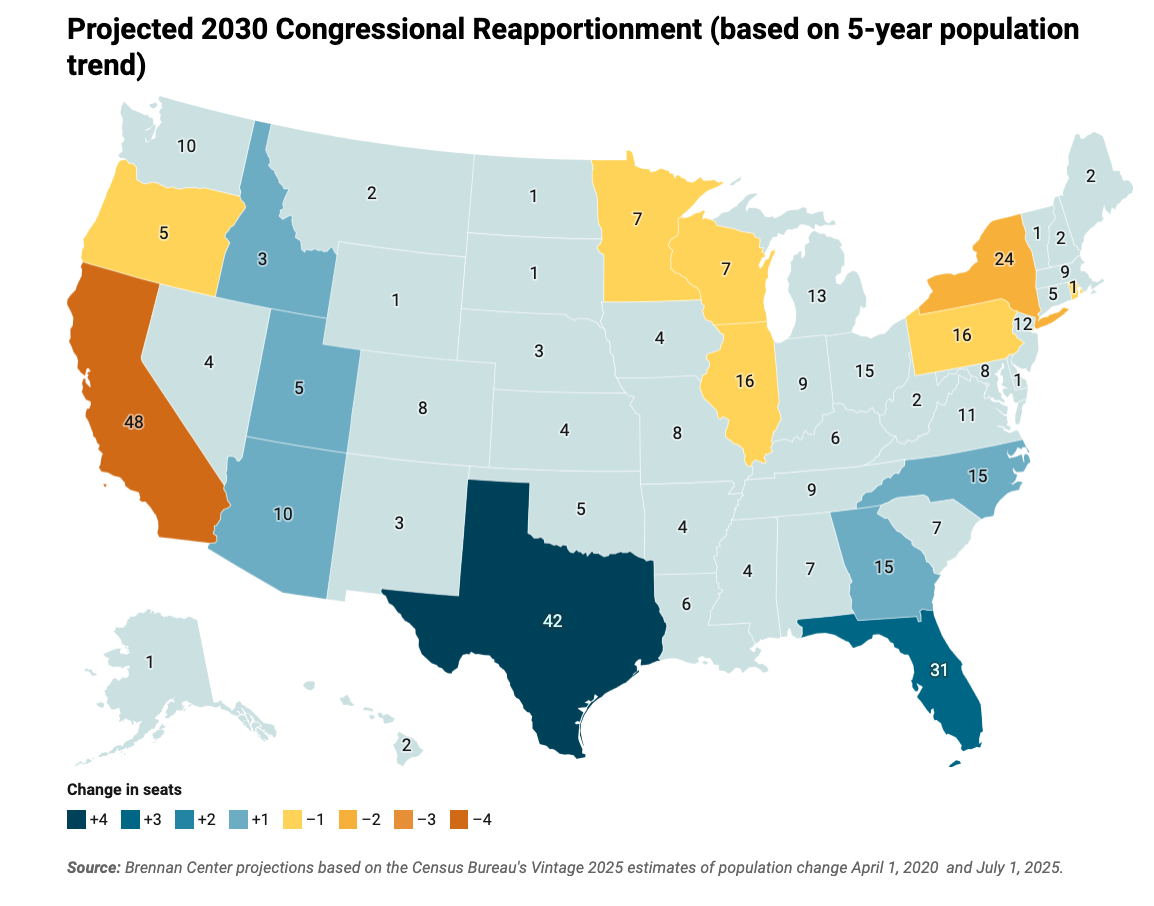
What states will lose House seats in 2030?
Critical Analysis
Find answers to the following questions using the visual above, your big brain, the information provided and any links below:
Reapportionment is the process of reallocating the 435 seats in the U.S. House of Representatives among the 50 states, conducted every 10 years based on census population changes. It redistributes political power, allowing states with population growth to gain seats and shrinking states to lose them. According to the visual above, in 2030 what state will gain the most new U.S. House districts?
According to the visual above, in 2030 how many U.S. House districts will the great state of North Carolina gain?
The U.S. population is not currently declining in total numbers, but its growth has slowed to historic lows due to a sharp drop in international migration and declining birth rates. While the population grew by 1.8 million from July 2024 to July 2025, it is aging rapidly, with absolute population decline projected to begin around 2056. Even after population decline begins, will there still be a need for reapportionment?
Describe one geographical pattern from the visual above.
By mandate of Article I, Section 2 of the U.S. Constitution, every ten years the U.S. Census is taken to determine the population of the nation and of each state. Those numbers are used to determine the number of Congressional districts each state gets. This is called reapportionment. Considering that California (Blue=Democratic) is projected to lose four seats and Texas (Red=Republican) is projected to gain four seats, how will the balance of power in the U.S. House likely tilt in 2030?
After states receive their total number of congressional seats they then get to redistrict (draw lines on a map to divide up their state) to determine where those seats go. This is called redistricting. Article I, section 4 of the U.S. Constitution mandates that, “The Times, Places and Manner of holding Elections for Senators and Representatives, shall be prescribed in each State by the Legislature thereof;” According to this, what body in each state is in charge of redistricting?
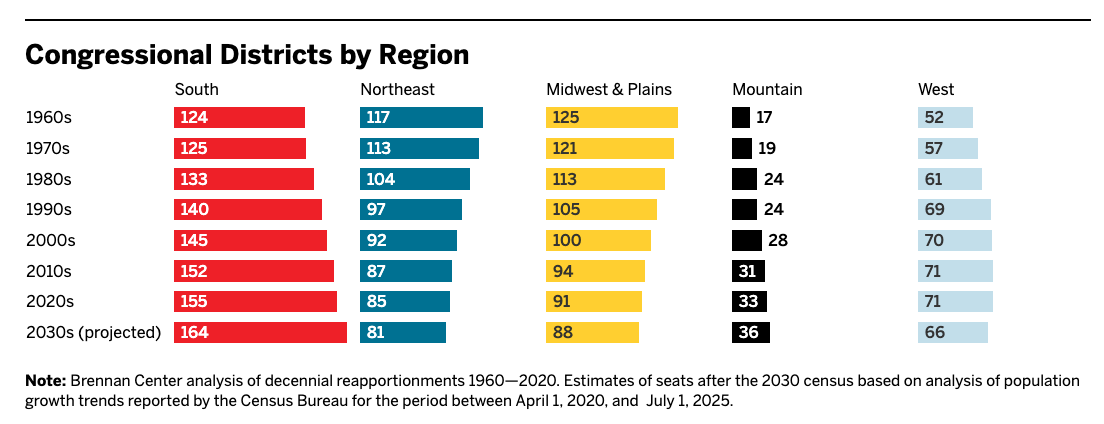
According to the visual below* what geographic region of the country has gained the most seats since 1960?
Considering that the South is the most conservative (Red) region of the country and the Northeast is among the most liberal (Blue), how do you think these changes have impacted American politics?
Why don’t we reapportion seats in the U.S. Senate?
In 2016, the Supreme Court ruled that a state is allowed to draw legislative districts based on its total population. "As the Framers of the Constitution and the Fourteenth Amendment comprehended, representatives serve all residents, not just those eligible or registered to vote," wrote the late Justice Ruth Bader Ginsburg in the court's unanimous opinion. Do you think that we should count all people when determining population or do you think we should only count adult citizens?
Get AP Exam Ready with anytime access to our fabulous gamified online exam-prep resources, self-guided workshops, interactive reviews, games, and exclusive content. This comprehensive suite of materials is specifically designed to help students master the content and skills required for success on the AP United States Government and Politics Exam, such as reading comprehension and concept application.


















Write and Discuss
Take ten minutes to write about the question at the top of the page and then discuss with your classmates.
Act on your Learning
Register to vote while you still can! You can register to vote online in less than five minutes.
Get Creative
Create a way to express the data in the visual above that even a 10 year old could understand.