
How close are we to Armageddon?
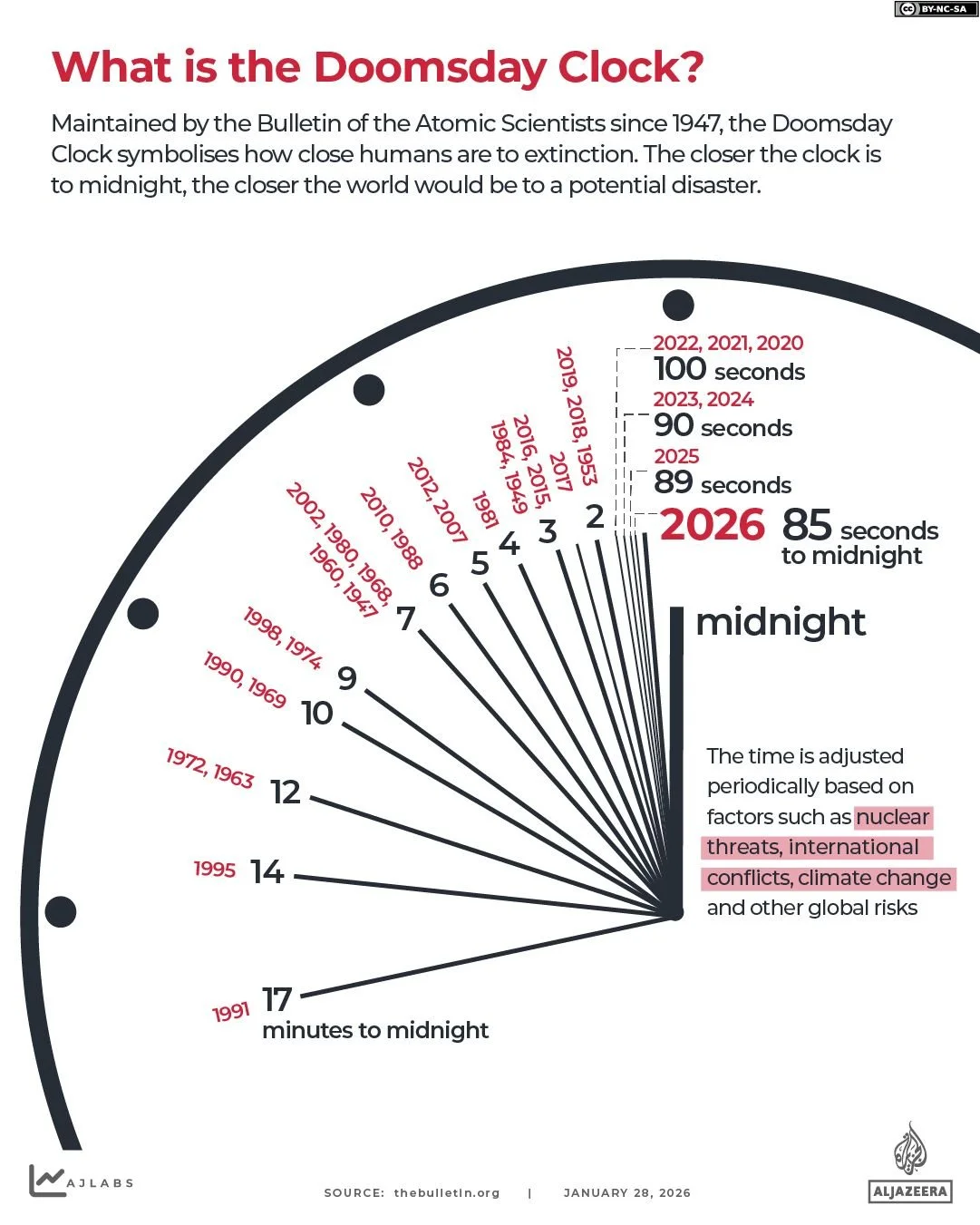
*A special thanks to Thalia Serino, AP US Government and Politics teacher extraordinaire at the world-famous Floyd E. Kellam High School - Go Knights!!!! - in Virginia Beach, Virginia. Whoot! Thanks so much for your dedication to your students and for sharing the fabulous infographic that is the basis of today’s lesson. Thank you Thalia!
Critical Analysis
Find answers to the following questions using the visual above, any links below, your big brain, and your knowledge of American government and politics:
According to the data in the visual above from the Bulletin of Atomic Scientists, currently how close are we to the end of humanity at midnight (extinction/doomsday/Armageddon)?
According to the visual above, since the doomsday clock began tracking, what is the furthest we have been Armageddon?
The Doomsday Clock was created in 1947 by the Bulletin of the Atomic Scientists, which was founded two years earlier by scientists Albert Einstein, J Robert Oppenheimer and Eugene Rabinowitch along with University of Chicago scholars. During that time, the clock was set at seven minutes to midnight. But after the Soviet Union successfully tested its first atomic bomb in 1949, Rabinowitch, who was then the bulletin’s editor, moved the clock to three minutes to midnight. According to the University of Chicago, until recently, the closest it had ever been set was at two minutes to midnight: in 1953 when the US and the Soviet Union tested thermonuclear weapons and in 2018 because of “a breakdown in the international order, of nuclear actors, as well as the continuing lack of action on climate change”. According to the visual above, since the doomsday clock began tracking, what is the closest we have been Armageddon?
Why do you think humankind has been moving closer and closer to extinction since 1947?
In setting the Clock four seconds closer to midnight, the Science and Security Board sends a stark signal: Because the world is already perilously close to the precipice, a move of even a single second should be taken as an indication of extreme danger and an unmistakable warning that every second of delay in reversing course increases the probability of global disaster. What do you think the government of the United States should do to try to mitigate the risk of human extinction?
The Doomsday Clock is a design that warns the public about how close we are to destroying our world with dangerous technologies of our own making. It is a metaphor, a reminder of the perils we must address if we are to survive on the planet. When the Doomsday Clock was created in 1947, the greatest danger to humanity came from nuclear weapons, in particular from the prospect that the United States and the Soviet Union were headed for a nuclear arms race. The Bulletin considered possible catastrophic disruptions from climate change in its hand-setting deliberations for the first time in 2007. There are now four areas that the Bulletin of Atomic Scientists are most concerned about when deciding on the time of the doomsday clock and our proximity to extinction. 1)Nuclear risk. 2)Climate Change. 3)Biological Threats. 4)Disruptive Technologies. Explain which of these four threats you think is most dangerous to humankind.
According to the data from the visual below*, the number of nuclear weapons in the world has dropped dramatically since about 1989.* The New Strategic Arms Reduction Treaty (New START), the last binding treaty limiting U.S. and Russian nuclear arsenals, was signed on July 31, 1991 and officially expired on February 5, 2026. Its expiration ends over 50 years of bilateral arms control, removing constraints on strategic nuclear weapons and eliminating inspection regimes. This creates an unconstrained environment for nuclear expansion amid rising global tensions. How will this impact the Doomsday clock?
If you were a member of the U.S. government would you want to restart START?
Describe some of the most important members of the United States government (in any branch of government, but particularly in the executive branch) who are most responsible for America’s security.
One year of the Trump presidency moved the doomsday clock four seconds closer to Armageddon. How do you think the next year of the Trump presidency will impact the setting of the clock one year from now?
Write and Discuss
Take ten minutes to write about the question at the top of the page and then discuss with your classmates.
Act on your Learning
Register to vote now. It’s about time.
Get Creative
Make your own Doomsday clock and set it based on your own thoughts about our species’ stewardship of the planet earth. Share it with class.
Learning Extension
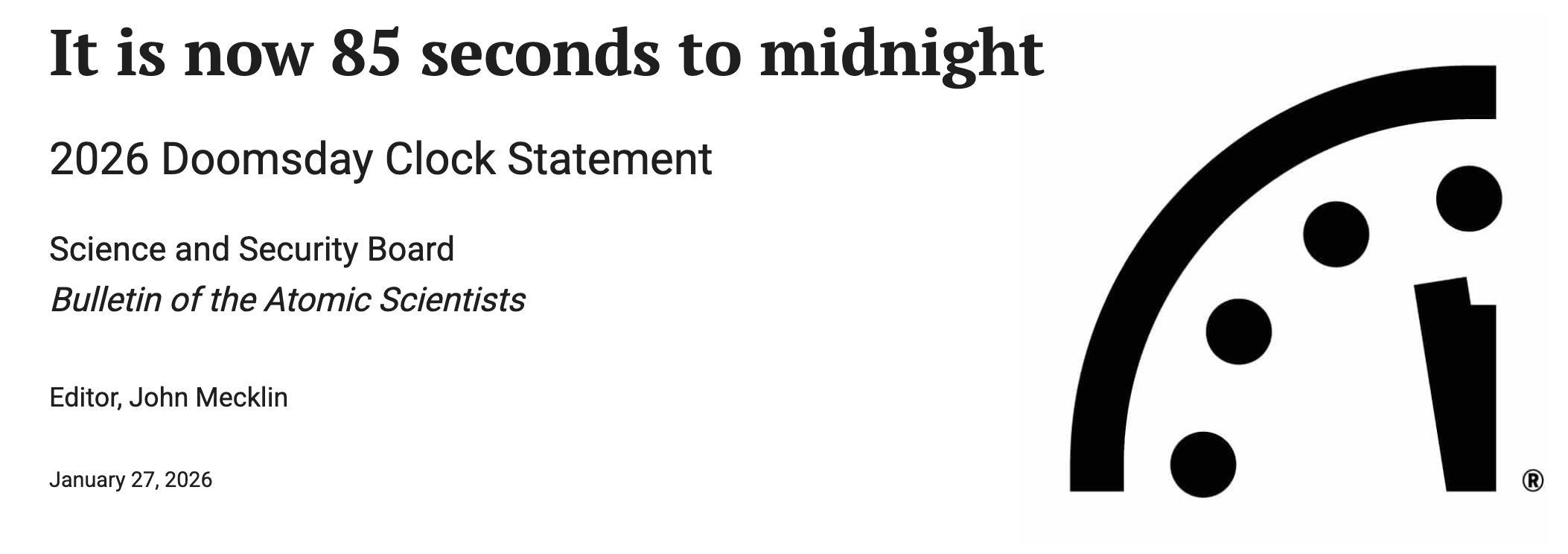
Learn more about the Doomsday Clock from the Bulletin of Atomic Scientists.

-
Amendments
11
- Oct 27, 2025 Twenty Second Amendment
- Feb 29, 2024 First Amendment
- Feb 28, 2024 Second Amendment
- Feb 27, 2024 Fourth Amendment
- Feb 26, 2024 Fifth Amendment
- Feb 19, 2024 Sixth Amendment
- Feb 18, 2024 Seventh Amendment
- Feb 17, 2024 Eighth Amendment
- Feb 9, 2024 Ninth Amendment
- Feb 5, 2024 Tenth Amendment
- Feb 2, 2024 Fourteenth Amendment
-
Foundational Documents
9
- Apr 12, 2024 Declaration of Independence
- Apr 4, 2024 Articles of Confederation
- Apr 3, 2024 The United States Constitution
- Apr 2, 2024 Brutus 1
- Apr 2, 2024 Federalist No. 10
- Apr 2, 2024 Federalist No. 51
- Mar 20, 2024 Federalist No. 70
- Mar 19, 2024 Federalist No. 78
- Aug 5, 2021 Letter From Birmingham Jail
-
Supreme Court Cases
14
- Apr 14, 2024 Marbury v. Madison (1803)
- Apr 14, 2024 McCulloch v. Maryland (1819)
- Apr 12, 2024 Schenck v. United States (1919)
- Apr 11, 2024 Brown v. Board of Education (1954)
- Apr 10, 2024 Baker v. Carr (1962)
- Apr 8, 2024 Engel v. Vitale
- Apr 7, 2024 Gideon v. Wainwright
- Apr 5, 2024 Tinker v. Des Moines
- Apr 4, 2024 New York Times v. US
- Apr 3, 2024 Wisconsin v. Yoder
- Apr 2, 2024 Shaw v. Reno
- Apr 1, 2024 U.S. v. Lopez
- Mar 30, 2024 Citizens United v. F.E.C.
- Mar 27, 2024 McDonald v. Chicago
-
UNIT 1
40
- Feb 5, 2025 State Capture
- Dec 27, 2024 Tyranny
- Nov 15, 2024 Separation of Powers
- Nov 15, 2024 Framers
- Apr 24, 2024 Impoundment
- Apr 24, 2024 Referendum
- Apr 11, 2024 Federal Mandate
- Apr 11, 2024 Autocracy
- Apr 4, 2024 Articles of Confederation
- Apr 3, 2024 The United States Constitution
- Apr 2, 2024 Categorical Grant
- Apr 2, 2024 Block Grant
- Apr 2, 2024 Federalist No. 51
- Mar 20, 2024 Commerce Clause
- Mar 19, 2024 Bicameralism
- Mar 12, 2024 Connecticut Compromise/Great Compromise
- Mar 12, 2024 New Jersey Plan
- Mar 7, 2024 Interstate Compact
- Mar 6, 2024 Shay’s Rebellion
- Mar 6, 2024 Necessary and Proper Clause
- Mar 5, 2024 Reserved Powers
- Mar 5, 2024 Concurrent Powers
- Mar 5, 2024 National Supremacy
- Mar 4, 2024 Virginia Plan
- Mar 1, 2024 Enumerated Powers
- Mar 1, 2024 Natural Rights
- Feb 27, 2024 Popular Sovereignty
- Feb 27, 2024 Federalism
- Oct 12, 2023 Limited Government
- Feb 16, 2023 Pluralist Democracy
- Aug 30, 2019 Elite democracy
- Aug 30, 2019 Participatory democracy
- Mar 20, 2019 Selective Incorporation
- Mar 18, 2019 Expressed Powers
- Feb 9, 2018 Extradition
- Feb 2, 2018 Preemption
- Feb 22, 2017 Eminent Domain
- Feb 21, 2017 Double Jeopardy
- Jan 31, 2017 Refugee
- Jan 16, 2017 Implied Powers
-
UNIT 2
68
- Oct 10, 2025 Government Shutdown
- Sep 17, 2025 Shadow Docket
- Aug 29, 2025 Jury Nullification
- Feb 26, 2025 Regulatory Capture
- Feb 21, 2025 Merit System/Spoils System
- Feb 21, 2025 Civil Service
- Feb 14, 2025 Executive Aggrandizement
- Feb 5, 2025 Impoundment
- Jan 30, 2025 Executive Order
- Dec 17, 2024 Federal Election Commission (FEC)
- Dec 6, 2024 It's A Trap
- Dec 6, 2024 Executive Privilege
- Dec 5, 2024 Impeachment
- Dec 5, 2024 Environmental Protection Agency (EPA)
- Dec 5, 2024 Department of Education
- Dec 4, 2024 Pardon
- Nov 20, 2024 Unified Government/Party Government
- Nov 19, 2024 Federal Communications Commission (FCC)
- Nov 15, 2024 Independent Agencies/Commissions
- Nov 15, 2024 Federal Bureaucracy
- Jul 5, 2024 Unitary Executive Theory
- May 22, 2024 Commander in Chief
- Apr 25, 2024 Rule of Four
- Apr 18, 2024 Trustee
- Apr 18, 2024 Delegate
- Apr 18, 2024 Politico
- Apr 16, 2024 Divided Government
- Apr 16, 2024 Congressional Whip
- Apr 15, 2024 Speaker of the House
- Apr 15, 2024 Closed Rule
- Apr 5, 2024 Congressional Committees
- Apr 5, 2024 Rule Making Authority
- Apr 2, 2024 Coattail Effect
- Apr 2, 2024 Signing Statement
- Mar 20, 2024 Congressional Oversight
- Mar 14, 2024 Federal Reserve
- Mar 6, 2024 Redistricting
- Mar 6, 2024 Reapportionment
- Mar 5, 2024 Full Faith and Credit Clause
- Mar 5, 2024 Safe Seats
- Feb 19, 2024 Judicial Review
- Feb 16, 2024 Filibuster
- Feb 19, 2019 Bureaucratic Rule-Making
- Feb 19, 2019 White House Staff
- Feb 20, 2018 Conference Committee
- Feb 16, 2018 Office of Management and Budget
- Feb 8, 2018 Precedent
- Feb 7, 2018 Congressional Budget Office
- Jan 26, 2018 Federal Register
- Jan 19, 2018 Gerrymander
- Jan 18, 2018 Party Caucus
- Jan 16, 2018 Executive Office of the President
- Jan 11, 2018 Gross domestic product (GDP)
- Mar 3, 2017 Regulation
- Feb 23, 2017 Treaty
- Feb 20, 2017 Executive Privilege
- Feb 14, 2017 Logrolling
- Feb 10, 2017 Fiscal Policy
- Feb 7, 2017 Rally Point
- Feb 6, 2017 Cabinet
- Feb 2, 2017 Senate Confirmation
- Feb 1, 2017 National Security Council
- Jan 28, 2017 Tariff
- Jan 27, 2017 Chief of Staff
- Jan 18, 2017 Pocket Veto
- Jan 17, 2017 Entitlements
- Dec 22, 2016 Presidential Honeymoon
- Dec 16, 2016 Cloture
-
UNIT 3
23
- Aug 29, 2025 Jury Nullification
- Mar 17, 2025 Racially Restrictive Covenants
- Apr 11, 2024 Brown v. Board of Education (1954)
- Apr 10, 2024 Baker v. Carr (1962)
- Apr 7, 2024 Gideon v. Wainwright
- Apr 5, 2024 Tinker v. Des Moines
- Apr 5, 2024 Docket
- Apr 5, 2024 Mass Movements
- Mar 13, 2024 Establishment Clause
- Mar 13, 2024 Free Exercise Clause
- Mar 13, 2024 Clear and Present Danger Test
- Mar 13, 2024 Amicus Curiae (friend of the court) Brief
- Feb 2, 2024 Fourteenth Amendment
- Mar 20, 2019 Selective Incorporation
- Jan 29, 2018 Commercial Speech
- Jan 17, 2018 Exclusionary Rule
- Jan 15, 2018 White Primary
- Feb 27, 2017 Fighting Words
- Feb 22, 2017 Eminent Domain
- Feb 21, 2017 Double Jeopardy
- Feb 15, 2017 Plea Bargain
- Feb 3, 2017 Civil Disobedience
- Jan 24, 2017 Jim Crow Laws
-
UNIT 4
27
- Oct 24, 2025 Extrajudicial Killing
- Dec 18, 2024 Debt
- Dec 18, 2024 Deficit
- Dec 2, 2024 Tariff
- Nov 19, 2024 Political Norms
- Nov 11, 2024 The Big Sort
- Oct 2, 2024 Waffle House
- May 3, 2024 Reinforcing Cleavages
- May 3, 2024 Cross-Cutting Cleavages
- Apr 22, 2024 Gender Gap
- Apr 22, 2024 Political Socialization
- Apr 16, 2024 Political Culture
- Mar 20, 2024 Entitlements
- Mar 19, 2024 American Dream
- Mar 19, 2024 Socialism
- Mar 19, 2024 Libertarianism
- Mar 14, 2024 Sampling Error
- Mar 14, 2024 Exit Polls
- Mar 14, 2024 Public Opinion
- Mar 13, 2024 Conservativism
- Mar 13, 2024 Liberalism
- Mar 13, 2024 Political Ideology
- Mar 12, 2024 Fiscal Policy
- Mar 12, 2024 Monetary Policy
- Mar 12, 2024 Political Efficacy
- Mar 29, 2019 Rule of Law
- Feb 28, 2017 Ethnocentrism
-
UNIT 5
39
- Oct 23, 2025 Dark Money
- Dec 27, 2024 Scooby Doo
- Dec 6, 2024 Media Bubble/News Bubble/Echo Chamber
- Oct 1, 2024 Beagle
- Jun 25, 2024 Horse Race Journalism
- Apr 25, 2024 Voter Turnout
- Apr 25, 2024 Purple State/Swing State
- Apr 25, 2024 Blue State
- Apr 25, 2024 Red State
- Apr 24, 2024 Off-Year Election
- Apr 22, 2024 Cracking
- Apr 22, 2024 Packing
- Apr 22, 2024 Rational choice theory
- Apr 22, 2024 Party line voting
- Apr 5, 2024 Political Polarization
- Apr 5, 2024 Mass Movements
- Apr 2, 2024 Coattail Effect
- Mar 22, 2024 Bundling
- Mar 22, 2024 Party Convention
- Mar 22, 2024 Name Recognition
- Mar 20, 2024 Term Limits
- Mar 20, 2024 Party Platform
- Mar 12, 2024 Primary election
- Mar 12, 2024 Caucus election
- Mar 12, 2024 PAC
- Mar 12, 2024 Super PAC
- Mar 11, 2024 Midterm Election
- Mar 11, 2024 Bipartisan
- Mar 11, 2024 Lobbyist
- Mar 11, 2024 Single Member District
- Mar 6, 2024 Selective Exposure
- Mar 6, 2024 Linkage Institutions
- Mar 5, 2024 Safe Seats
- Mar 5, 2019 Spoils System
- Jan 22, 2018 Closed Primary
- Jan 19, 2018 Gerrymander
- Mar 13, 2017 Realigning Election
- Feb 3, 2017 Civil Disobedience
- Jan 11, 2017 Party Identification